
 Tweet
Tweet
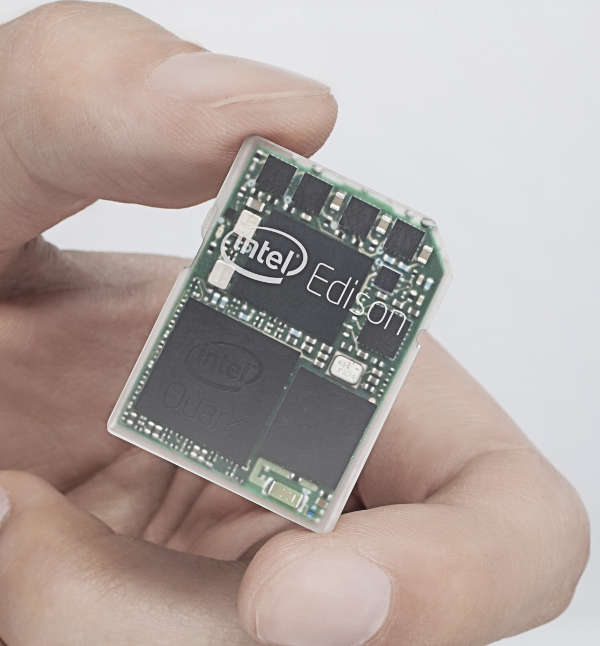
CES 2014 Intel has put a PC into an SD card-sized casing. Dubbed Edison, the micro-microcomputer marks the chip giant’s first attempt to address the emerging wearable computing business; part of its strategy to cope with a world where punters buy far fewer traditional personal computers.
Or, more specifically, where ARM and not Intel is the dominant processor platform.
Edison is based on Intel’s Quark chip, which it launched last year as its attempt to muscle in on that other flavour-of-the-month market: the so-called Internet of Things. It also reflects the company’s new-found keenness on the "maker" community.
Quark, a 32-bit low-power x86 processor, sits inside Intel’s Arduino-compatible Raspberry Pi-alike Galileo board computer. Edison takes the same chip, connects it to a wee bit of LPDDR2 memory and Flash storage, and plugs in Bluetooth 4.0 Smart - aka LE - and Wi-Fi for broader connectivity.
 While Edison is based on the established SD card form-factor, Intel hasn’t confirmed the card uses the storage format’s electrical interface. We assume it does: there would be little point in adopting the SD card size and shape if developers couldn’t fit a low-cost SD card slot onto their project boards to take the Intel card.
Intel’s approach is identical to that of Anglo-American Internet of Things startup Electric Imp, which has been offering an SD card-sized device for almost a year. Unlike Edison, the ARM-based Imp, in either its slot-in SD card or solder-on form, lacks Bluetooth Smart for device-to-device connectivity. Instead, it uses Wi-Fi to connect code running on the card to web- or app-based user interfaces via the firm’s servers.
Indeed, that’s a key aspect Edison lacks: a dedicated server infrastructure developers - be they individual makers, small startups or even major OEMs - can leverage to link IoT hardware embedded in their products to apps on users’ phones, tablets or traditional computers.
To be fair, Edison is aimed more at the wearables market than IoT applications, though its form-factor makes it suitable for both. In any case, Imp is available now; Edison won’t be available, Intel said, until the summer.
Edison was unveiled yesterday during Intel CEO Brian Krzanich’s Consumer Electronics Show (CES) keynote. He also whipped out various wearable reference designs, including a Bluetooth headset to communicate with phones’ personal assistant apps, such as Siri and Google Now, and a pair of earphones with integrated biometric sensors. ®
Or, more specifically, where ARM and not Intel is the dominant processor platform.
Edison is based on Intel’s Quark chip, which it launched last year as its attempt to muscle in on that other flavour-of-the-month market: the so-called Internet of Things. It also reflects the company’s new-found keenness on the "maker" community.
Quark, a 32-bit low-power x86 processor, sits inside Intel’s Arduino-compatible Raspberry Pi-alike Galileo board computer. Edison takes the same chip, connects it to a wee bit of LPDDR2 memory and Flash storage, and plugs in Bluetooth 4.0 Smart - aka LE - and Wi-Fi for broader connectivity.
Intel’s approach is identical to that of Anglo-American Internet of Things startup Electric Imp, which has been offering an SD card-sized device for almost a year. Unlike Edison, the ARM-based Imp, in either its slot-in SD card or solder-on form, lacks Bluetooth Smart for device-to-device connectivity. Instead, it uses Wi-Fi to connect code running on the card to web- or app-based user interfaces via the firm’s servers.
Indeed, that’s a key aspect Edison lacks: a dedicated server infrastructure developers - be they individual makers, small startups or even major OEMs - can leverage to link IoT hardware embedded in their products to apps on users’ phones, tablets or traditional computers.
To be fair, Edison is aimed more at the wearables market than IoT applications, though its form-factor makes it suitable for both. In any case, Imp is available now; Edison won’t be available, Intel said, until the summer.
Edison was unveiled yesterday during Intel CEO Brian Krzanich’s Consumer Electronics Show (CES) keynote. He also whipped out various wearable reference designs, including a Bluetooth headset to communicate with phones’ personal assistant apps, such as Siri and Google Now, and a pair of earphones with integrated biometric sensors. ®

Comment