 Tweet
Tweet
Baer's Odyssey: Meet the serial inventor who built the world’s first game console
Ars catches up with the 91 year old creator of the video game console.
By Declan Burrowes - Jul 13, 2013 3:00 P.M. UTC
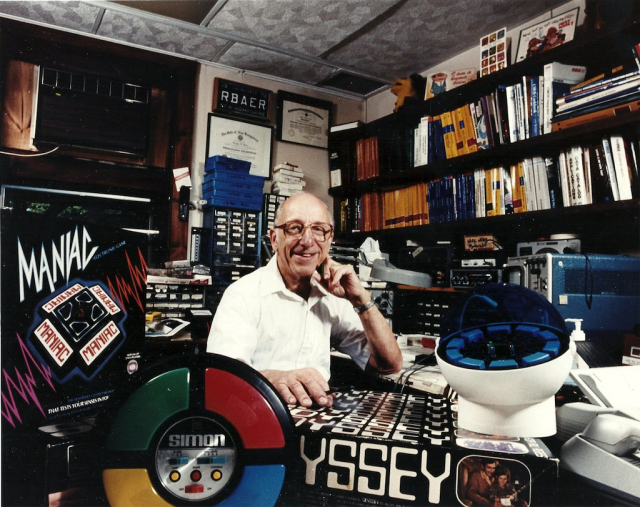
Ralph Baer posing in his personal lab with some of his most famous products. Ralph Baer Collection
Even if you're a devoted fan of video games, there's a decent chance you're not familiar with the name Ralph H. Baer. This should be considered gamer high treason considering Baer's importance in creating the concept of home video games and the vast, varied entertainment ecosystem now built upon them. Despite being the one to push the dominoes toward an industry that currently makes billions of dollars annually, the bulk of the gaming community has largely forgotten about him.
Now a 91 year old widower, the German-born Baer is the inventor of the Magnavox Odyssey, the world’s first video game console. The Odyssey is predated in the games-on-screens space only by experiments like Willy Higinbotham's Tennis for Two and the coin-op dud Computer Space. But Baer also has a long and distinguished record as an engineer and inventor. The list of patents and gadgets in his name encompasses surgical-cutting equipment, “muscle-toning pulse generators,” submarine-tracking radar systems, video simulations for trainee pilots, talking books and talking doormats, iconic ‘80s toys like SIMON and Laser Command, and even launch displays and a lunar-resistant camera grip for the Saturn V and Apollo 11 space programs.
Invention, he told Ars during a recent interview, is as natural to him as breathing.
Still, by his own admittance, his greatest creation is the video game console. There’s no question that Baer is extremely proud of that invention's lineage. When asked if he feels directly responsible for modern consoles like the Xbox 360 and PlayStation 3, his answer is clear-cut. “Totally.”
Ralph H. Baer: Origins
Baer was born in the Rhineland in 1922 into a fallen German Empire crippled by unprecedented debt and stricken by national shame and misery following a catastrophic defeat in the First World War. This wretched interbellum period witnessed the rise of the charismatic Nazi leader Adolf Hitler, and it was his violent and exclusionary anti-Semitic policies that drove Baer and his family first to the Netherlands and eventually to the United States in 1938.
As a young man, the immigrant Baer showed a flair for engineering and invention. In 1940, after a correspondence course at the National Radio Institute in Washington DC, he graduated as a radio technician. Then war came. Baer was drafted into the US Army in 1943 as a Private, where he served in Military Intelligence under Eisenhower. His degree and his natural affinity for machinery saw him writing invaluable training documents for Allied soldiers preparing for D-Day. Two years after his return from Europe in 1946, the 23-year-old began studying for the world’s first Bachelor of Science in Television Engineering at the American Television Institute in Chicago (founded by the inventor of the mechanical television, Ulises Armand Sanabria). Keep in mind that this was at a time when there were only a few thousand TV sets in the entire country.
Baer commenced his career servicing and repairing television and radio sets out of a small shop in New York, and he later worked with several electronics firms. It was in 1955, while working for Loral Electronics Corporation, that Baer recalls being tasked with “building the best television set ever.” Not perturbed in the slightest by this monumental challenge, he had a novel thought that would ultimately change the face of the entertainment industry forever: “TV gaming.” This, Baer tells me, was his “epiphany.”
Unfortunately, as Baer recalls, “management said no.” Loral considered the idea of games on TV a little too outlandish and a little too expensive at the time. Already behind schedule, the company pushed forward with plans for a TV set without games. For 11 years, Baer’s idea hibernated, biding its time for the right moment.
Let’s play television games!
 Baer poses with the Odyssey in 1972. Ralph Baer Collection
With the rise of color television and low-cost electronic components, TV gaming was more feasible than ever by 1966. Now chief engineer for equipment design at Sanders Associates (a defense contractor), Baer remembers hastily writing down his ideas on a notepad as he waited at a New York bus terminal. What resulted was a four-page document for a TV “game box," playable on channels 3 or 4 (channel “LP”—“Let’s Play”—as he dubbed it). Baer set down plans for action and sports games (“in which skill of manual dexterity or observation is to play a part”), as well as playing card and instructional games, the latter designed to “teach the basics of geometry and basic arithmetic.”
The game box was intended to have universal appeal, bringing the family unit closer together and creating interactive entertainment around a traditionally passive device. The more than 40 million television sets in the United States at the time were “literally begging to be used” for more than just the 6pm news, as Baer puts it.
From September 1966 to February 1967, Baer and fellow engineer Bob Tremblay designed a proof-of-concept device which allowed the user to move a white dot around the screen and change its size. Confident in this idea, Baer pitched Chase—a two-player game where the objective was to tail and chase the opposing player’s white dot—to Herb Campman, Sanders’ Corporate Director. Intrigued but reserved, Campman approved $2,500 of funding for the project (worth about $17,000 today) on the condition that it “do more interesting things,” Baer said.
Fully financed, Baer and Tremblay, and two more engineers, Bob Rusch and Bill Harrison, began work on a number of prototype “TV Game Units.” By 1968, a seventh iteration, “The Brown Box” (so-called because of the fashionable wood grain adhesive on the device’s cover) was finished, complete with circuitry for color output and a number of built-in games, including variations of Chase, Handball, Golf, and Ping Pong (later renamed Table Tennis). Players controlled the action via two large paddle controls with rotary dials and switches. A basic light gun peripheral—which, Baer reminded me, was another invention of his—was also produced for simple target-shooting games.
The next step for Baer and Nutting was licensing the Brown Box to a manufacturer. While many companies were impressed with the novel technologies and ideas Baer employed, the likes of General Electronics and Motorola were not willing to take the risk or couldn't envisage the target market. It was an enthusiastic VP of marketing at Magnavox, Gerry Martin, who first understood the machine’s potential, but it took Martin until 1971 to convince a boardroom of corporate managers that TV games were the next big thing. Martin’s persistence, backed by a solid product, paid off when the Magnavox suits agreed to move forward with the production of the Odyssey model 1TL200.
Compromise was necessary even at this early stage, however. The Brown Box’s color circuitry was thrown out to lower costs, replaced with cheap plastic overlays that were attached to the player’s TV screen. In addition, the 16 switches used to alternate games were replaced with smaller circuit boards that plugged into the main motherboard. While these “jumpers” resembled the cartridges that would hold game data in later consoles, they contained no internal circuitry and simply connected the internal circuits in the Odyssey together in such a way that different built-in games could be played.
The Odyssey was basic even for the time. It was battery-powered and couldn't output sound. The simple white dots it displayed required a lot of imagination to create believable scenes, even with the colorful screen overlays. The console lacked a built-in scoring system, so points and records in Table Tennis and Football were noted on themed, printed score sheets. Roulette and Simon Says used physical cards, paper notes, and dice. In a sense, many of the Odyssey’s games were board games with a bizarre (but exciting) TV element.
Unsurprisingly, the Odyssey garnered immediate attention at trade shows and press events. The idea of a television viewer controlling an object on a screen was practically inconceivable at the time. Dealers and journalists were left scrambling to lift their jaws from the floor, and the electronics media was abuzz with talk of Magnavox’s revolutionary “mystery product.” It was a massive, unprecedented step forward for entertainment.
The (uneasy) birth of an industry
[img]//cdn.arstechnica.net/wp-content/uploads/2013/07/All-TVG-replicas-10-17-06-1-copy-4-640x167.jpg[/img]Enlarge / All the TV Game products Baer developed. Ralph Baer Collection
The Odyssey was released to the public in September 1972, and despite a few marketing gaffes (including one that led consumers to believe the machine was only usable with Magnavox television sets) and licensing issues, the console caused a minor sensation, shifting 130,000 units by Christmas. By 1975, when the 1TL200 was discontinued, over 330,000 consoles and 80,000 light gun rifle packs had been sold.
In May 1972, Nolan Bushnell—later to become President of Atari—attended a private demonstration of the Odyssey in Burlingame, California. In 1971, Bushnell had beat Baer to market with a coin-operated space shooter, Computer Space, based on the 1962 MIT computer game experiment, Spacewar!. The complicated game failed to find much of an audience in the bar scene, though, so Bushnell went looking for new opportunities.
In Burlingame, Bushnell witnessed the Odyssey's Table Tennis in action but left disappointed. Bushnell later claimed that he “didn’t think it was very clever.” But that didn't stop him and his colleague, Al Alcorn, from beginning work on an arcade machine that would improve on Baer’s design. In 1973, Pong was born. With its built-in scoring system and eponymous sound effect, it proved an immediate hit.
Despite losing a lawsuit to Magnavox and Sanders for patent infringement, Atari went on to secure lengthy dominion over both the home console market and the arcade scene. While Baer was willing to concede Bushnell’s creation of the arcade video game market, the bitter legal dispute between the pair—and the wider cultural dispute over who is the real “father of video games”—has torn a lasting rift. “[Bushnell] has been telling the same nonsensical stories for 40 years,” Baer said. “He just cannot let go of them because they affect his legacy. As for how I feel about that? Life’s too short to hold grudges.”
Baer’s involvement in video games was almost entirely limited to his work in the 1970's. The success of Atari in the arcade and at home inspired a wealth of new competitors to create their own cheap two- or three-game copycat consoles, most of them dedicated solely to their own Pong clones. Magnavox released its own simpler, dedicated Pong-inspired console, the Odyssey 100, in 1975. In doing so, it contributed to a massive console glut that led to the first great video game market crash in 1977. Magnavox remained largely aloof to Baer’s ideas for improvement, and the company remained content to churn out dedicated consoles that lacked the refinement of the 1TL200.
Fortunately, not every manufacturer was as myopic. “When Magnavox became less than cooperative, I turned to Coleco and helped them get their first Telstar system into production via an early G.I. AY-3-8500 single chip device,” Baer recalled. “Then I got them past the FCC interference tests, which they had flunked the first time around, and wound up getting engineering contracts from Coleco to help them design the next generation of Coleco videogames.”
He briefly returned to Magnavox to champion the Odyssey², released in 1978. Originally shelved by the company but revived by Baer, it carried his flair for innovation, including a membrane keyboard, a speech synthesis unit, and a special cartridge that allowed the user to program the machine. Even as a console that was largely ahead of its time, the Odyssey² managed to perform respectably against the cheaper and simpler competition of the Atari 2600 and Intellivision.
A legacy
[img]//cdn.arstechnica.net/wp-content/uploads/2013/07/RHB-with-TGs-10-07-640x441.jpg[/img]Enlarge / Baer posing with a collection of his creations in 2007.
It boggles the mind to consider just how far the video game industry has come since the Odyssey. Soundless, monochrome Table Tennis has evolved into a hugely diverse, creative entertainment and artistic medium that touches hundreds of millions of people across the planet.
That’s not to say that Baer is always proud of the industry he helped create. In the past, he has spoken out, albeit quietly, against the core industry's unbreakable attachment to bloody violence, especially as a casual motif. When asked if he thinks the focus will ever shift from guns and headshots, Baer’s reply is curt: “It won't. The same thing could be said of certain genres of books and other art forms that cater to the lowest common denominator.”
Still, Baer realizes that his opinions are his own. “[Violence] is what appeals to large segments of the game-playing population and there isn't a damn thing I can do about it,” he said. “The fact that there are many areas of that business that I personally find abhorrent is irrelevant.” The root of the problem, says Baer, lies with “contemporary society.”
Despite railing against some of the trends in modern gaming, Baer also pushed back against some cultural commentators that seem to think video games are still for kids. These critics bristle at the idea of adult themes and sexual content in the medium. “The majority of video game players are now 35 and over,” Baer said. “The criticisms come mostly from a generation that never played a video game in their life.”
Though there were a few video games and interactive TV experiments before the Odyssey, Baer is still duly proud of the important industry concepts he created. “I pioneered the concept of playing games on the screen of a common TV set, developed such things as low-cost joysticks, had a golf-putting game, invented and designed a series of different light-guns, and invented the concept of playing games in cooperation with a cable company,” he said.
But did early antecedents like Spacewar! inspire him at all? Was he even aware of their existence? “Spacewar! was played in universities by a generation of guys younger than me,” he said. “I had never even heard of it when I first came up with the idea for converting an ordinary TV set into an interactive game device.”
As for Willy Higinbotham's enigmatic Tennis for Two experiment in 1958, Baer implied that it was really because of him that the game became common knowledge at all. “Higinbotham was not heard of by anyone except for a small group of visitors to Brookhaven National Lab until Nintendo, in a lawsuit versus Magnavox/Sanders, brought him [in 1985] to the District Court of New York in an attempt to invalidate our patents,” he said. “It was a ridiculous attempt, and the judge threw it out expeditiously.”
What really sets Baer apart from the likes of Higinbotham, Russell, and even Bushnell, is that he was the first person to truly grasp the great potential of playing games on widely available television sets. He recognized how affordable, interactive experiences could be used to bring friends and family together—and that the innovative technology used to do so would create new and immersive ways to learn and have fun. It was that spark that formed an industry from what was, at that point, mainly a few campus hyper-geeks tinkering with Spacewar! on gigantic PDP-1 mainframes.
Presuming that the nonagenarian Baer spends his afternoons dozing off in the armchair to lunchtime talkshows, I rather stupidly asked him if he ever "tinkers" in his spare time. My choice of word does not go unnoticed. “I don't tinker,” he said. “I'm a professional engineer and inventor. I come up with novel concepts. I turn them into working hardware, do all of the circuit design and software myself, and build demo models adequate to take to potential licensees."
In fact, Baer says he still works full-time and that he has "half-a-dozen" toy and game ideas ready to spring to life on his work desk. But he admits that old age does have its issues. “My head may work like a 45-year-old’s but my plumbing and wiring is 91 years old, and that's no fun.”
How does Baer imagine his brainchild growing and maturing in the decades to come? “Video games are an art form. Like any other art form, video games express themselves in a huge variety of formats. The industry will continue to grow like the movie industry and produce large quantities of 'interactive movies' of a dozen different genres. Playing relatively simple but entertaining games will survive. That's especially true for mobile games that are taking over much of the casual game business.”
The return to Ithaca
Despite his key role in the creation of the game industry, Baer is largely the focus of a very particular sect of game history enthusiasts. Unlike Shigeru Miyamoto and even Nolan Bushnell, Baer “retired” from the game industry 30 years ago and moved onto other projects, perhaps before a great many of today’s game players could really appreciate his achievements. “I was a busy guy,” he says.
Does Baer feel left out or forgotten by the modern game industry? “In view of the fact that the President of the United States of America hung the National Medal of Technology around my neck in a White House ceremony in 2006, and in view of my having been inducted into the National Inventors Hall of Fame, I really don't feel neglected.”
Ars catches up with the 91 year old creator of the video game console.
By Declan Burrowes - Jul 13, 2013 3:00 P.M. UTC
Ralph Baer posing in his personal lab with some of his most famous products. Ralph Baer Collection
Even if you're a devoted fan of video games, there's a decent chance you're not familiar with the name Ralph H. Baer. This should be considered gamer high treason considering Baer's importance in creating the concept of home video games and the vast, varied entertainment ecosystem now built upon them. Despite being the one to push the dominoes toward an industry that currently makes billions of dollars annually, the bulk of the gaming community has largely forgotten about him.
Now a 91 year old widower, the German-born Baer is the inventor of the Magnavox Odyssey, the world’s first video game console. The Odyssey is predated in the games-on-screens space only by experiments like Willy Higinbotham's Tennis for Two and the coin-op dud Computer Space. But Baer also has a long and distinguished record as an engineer and inventor. The list of patents and gadgets in his name encompasses surgical-cutting equipment, “muscle-toning pulse generators,” submarine-tracking radar systems, video simulations for trainee pilots, talking books and talking doormats, iconic ‘80s toys like SIMON and Laser Command, and even launch displays and a lunar-resistant camera grip for the Saturn V and Apollo 11 space programs.
Invention, he told Ars during a recent interview, is as natural to him as breathing.
Still, by his own admittance, his greatest creation is the video game console. There’s no question that Baer is extremely proud of that invention's lineage. When asked if he feels directly responsible for modern consoles like the Xbox 360 and PlayStation 3, his answer is clear-cut. “Totally.”
Ralph H. Baer: Origins
Baer was born in the Rhineland in 1922 into a fallen German Empire crippled by unprecedented debt and stricken by national shame and misery following a catastrophic defeat in the First World War. This wretched interbellum period witnessed the rise of the charismatic Nazi leader Adolf Hitler, and it was his violent and exclusionary anti-Semitic policies that drove Baer and his family first to the Netherlands and eventually to the United States in 1938.
As a young man, the immigrant Baer showed a flair for engineering and invention. In 1940, after a correspondence course at the National Radio Institute in Washington DC, he graduated as a radio technician. Then war came. Baer was drafted into the US Army in 1943 as a Private, where he served in Military Intelligence under Eisenhower. His degree and his natural affinity for machinery saw him writing invaluable training documents for Allied soldiers preparing for D-Day. Two years after his return from Europe in 1946, the 23-year-old began studying for the world’s first Bachelor of Science in Television Engineering at the American Television Institute in Chicago (founded by the inventor of the mechanical television, Ulises Armand Sanabria). Keep in mind that this was at a time when there were only a few thousand TV sets in the entire country.
Baer commenced his career servicing and repairing television and radio sets out of a small shop in New York, and he later worked with several electronics firms. It was in 1955, while working for Loral Electronics Corporation, that Baer recalls being tasked with “building the best television set ever.” Not perturbed in the slightest by this monumental challenge, he had a novel thought that would ultimately change the face of the entertainment industry forever: “TV gaming.” This, Baer tells me, was his “epiphany.”
Unfortunately, as Baer recalls, “management said no.” Loral considered the idea of games on TV a little too outlandish and a little too expensive at the time. Already behind schedule, the company pushed forward with plans for a TV set without games. For 11 years, Baer’s idea hibernated, biding its time for the right moment.
Let’s play television games!
Baer poses with the Odyssey in 1972. Ralph Baer CollectionWith the rise of color television and low-cost electronic components, TV gaming was more feasible than ever by 1966. Now chief engineer for equipment design at Sanders Associates (a defense contractor), Baer remembers hastily writing down his ideas on a notepad as he waited at a New York bus terminal. What resulted was a four-page document for a TV “game box," playable on channels 3 or 4 (channel “LP”—“Let’s Play”—as he dubbed it). Baer set down plans for action and sports games (“in which skill of manual dexterity or observation is to play a part”), as well as playing card and instructional games, the latter designed to “teach the basics of geometry and basic arithmetic.”
The game box was intended to have universal appeal, bringing the family unit closer together and creating interactive entertainment around a traditionally passive device. The more than 40 million television sets in the United States at the time were “literally begging to be used” for more than just the 6pm news, as Baer puts it.
From September 1966 to February 1967, Baer and fellow engineer Bob Tremblay designed a proof-of-concept device which allowed the user to move a white dot around the screen and change its size. Confident in this idea, Baer pitched Chase—a two-player game where the objective was to tail and chase the opposing player’s white dot—to Herb Campman, Sanders’ Corporate Director. Intrigued but reserved, Campman approved $2,500 of funding for the project (worth about $17,000 today) on the condition that it “do more interesting things,” Baer said.
Fully financed, Baer and Tremblay, and two more engineers, Bob Rusch and Bill Harrison, began work on a number of prototype “TV Game Units.” By 1968, a seventh iteration, “The Brown Box” (so-called because of the fashionable wood grain adhesive on the device’s cover) was finished, complete with circuitry for color output and a number of built-in games, including variations of Chase, Handball, Golf, and Ping Pong (later renamed Table Tennis). Players controlled the action via two large paddle controls with rotary dials and switches. A basic light gun peripheral—which, Baer reminded me, was another invention of his—was also produced for simple target-shooting games.
The next step for Baer and Nutting was licensing the Brown Box to a manufacturer. While many companies were impressed with the novel technologies and ideas Baer employed, the likes of General Electronics and Motorola were not willing to take the risk or couldn't envisage the target market. It was an enthusiastic VP of marketing at Magnavox, Gerry Martin, who first understood the machine’s potential, but it took Martin until 1971 to convince a boardroom of corporate managers that TV games were the next big thing. Martin’s persistence, backed by a solid product, paid off when the Magnavox suits agreed to move forward with the production of the Odyssey model 1TL200.
Compromise was necessary even at this early stage, however. The Brown Box’s color circuitry was thrown out to lower costs, replaced with cheap plastic overlays that were attached to the player’s TV screen. In addition, the 16 switches used to alternate games were replaced with smaller circuit boards that plugged into the main motherboard. While these “jumpers” resembled the cartridges that would hold game data in later consoles, they contained no internal circuitry and simply connected the internal circuits in the Odyssey together in such a way that different built-in games could be played.
The Odyssey was basic even for the time. It was battery-powered and couldn't output sound. The simple white dots it displayed required a lot of imagination to create believable scenes, even with the colorful screen overlays. The console lacked a built-in scoring system, so points and records in Table Tennis and Football were noted on themed, printed score sheets. Roulette and Simon Says used physical cards, paper notes, and dice. In a sense, many of the Odyssey’s games were board games with a bizarre (but exciting) TV element.
Unsurprisingly, the Odyssey garnered immediate attention at trade shows and press events. The idea of a television viewer controlling an object on a screen was practically inconceivable at the time. Dealers and journalists were left scrambling to lift their jaws from the floor, and the electronics media was abuzz with talk of Magnavox’s revolutionary “mystery product.” It was a massive, unprecedented step forward for entertainment.
The (uneasy) birth of an industry
[img]//cdn.arstechnica.net/wp-content/uploads/2013/07/All-TVG-replicas-10-17-06-1-copy-4-640x167.jpg[/img]Enlarge / All the TV Game products Baer developed. Ralph Baer Collection
The Odyssey was released to the public in September 1972, and despite a few marketing gaffes (including one that led consumers to believe the machine was only usable with Magnavox television sets) and licensing issues, the console caused a minor sensation, shifting 130,000 units by Christmas. By 1975, when the 1TL200 was discontinued, over 330,000 consoles and 80,000 light gun rifle packs had been sold.
In May 1972, Nolan Bushnell—later to become President of Atari—attended a private demonstration of the Odyssey in Burlingame, California. In 1971, Bushnell had beat Baer to market with a coin-operated space shooter, Computer Space, based on the 1962 MIT computer game experiment, Spacewar!. The complicated game failed to find much of an audience in the bar scene, though, so Bushnell went looking for new opportunities.
In Burlingame, Bushnell witnessed the Odyssey's Table Tennis in action but left disappointed. Bushnell later claimed that he “didn’t think it was very clever.” But that didn't stop him and his colleague, Al Alcorn, from beginning work on an arcade machine that would improve on Baer’s design. In 1973, Pong was born. With its built-in scoring system and eponymous sound effect, it proved an immediate hit.
Despite losing a lawsuit to Magnavox and Sanders for patent infringement, Atari went on to secure lengthy dominion over both the home console market and the arcade scene. While Baer was willing to concede Bushnell’s creation of the arcade video game market, the bitter legal dispute between the pair—and the wider cultural dispute over who is the real “father of video games”—has torn a lasting rift. “[Bushnell] has been telling the same nonsensical stories for 40 years,” Baer said. “He just cannot let go of them because they affect his legacy. As for how I feel about that? Life’s too short to hold grudges.”
Baer’s involvement in video games was almost entirely limited to his work in the 1970's. The success of Atari in the arcade and at home inspired a wealth of new competitors to create their own cheap two- or three-game copycat consoles, most of them dedicated solely to their own Pong clones. Magnavox released its own simpler, dedicated Pong-inspired console, the Odyssey 100, in 1975. In doing so, it contributed to a massive console glut that led to the first great video game market crash in 1977. Magnavox remained largely aloof to Baer’s ideas for improvement, and the company remained content to churn out dedicated consoles that lacked the refinement of the 1TL200.
Fortunately, not every manufacturer was as myopic. “When Magnavox became less than cooperative, I turned to Coleco and helped them get their first Telstar system into production via an early G.I. AY-3-8500 single chip device,” Baer recalled. “Then I got them past the FCC interference tests, which they had flunked the first time around, and wound up getting engineering contracts from Coleco to help them design the next generation of Coleco videogames.”
He briefly returned to Magnavox to champion the Odyssey², released in 1978. Originally shelved by the company but revived by Baer, it carried his flair for innovation, including a membrane keyboard, a speech synthesis unit, and a special cartridge that allowed the user to program the machine. Even as a console that was largely ahead of its time, the Odyssey² managed to perform respectably against the cheaper and simpler competition of the Atari 2600 and Intellivision.
A legacy
[img]//cdn.arstechnica.net/wp-content/uploads/2013/07/RHB-with-TGs-10-07-640x441.jpg[/img]Enlarge / Baer posing with a collection of his creations in 2007.
It boggles the mind to consider just how far the video game industry has come since the Odyssey. Soundless, monochrome Table Tennis has evolved into a hugely diverse, creative entertainment and artistic medium that touches hundreds of millions of people across the planet.
That’s not to say that Baer is always proud of the industry he helped create. In the past, he has spoken out, albeit quietly, against the core industry's unbreakable attachment to bloody violence, especially as a casual motif. When asked if he thinks the focus will ever shift from guns and headshots, Baer’s reply is curt: “It won't. The same thing could be said of certain genres of books and other art forms that cater to the lowest common denominator.”
Still, Baer realizes that his opinions are his own. “[Violence] is what appeals to large segments of the game-playing population and there isn't a damn thing I can do about it,” he said. “The fact that there are many areas of that business that I personally find abhorrent is irrelevant.” The root of the problem, says Baer, lies with “contemporary society.”
Despite railing against some of the trends in modern gaming, Baer also pushed back against some cultural commentators that seem to think video games are still for kids. These critics bristle at the idea of adult themes and sexual content in the medium. “The majority of video game players are now 35 and over,” Baer said. “The criticisms come mostly from a generation that never played a video game in their life.”
Though there were a few video games and interactive TV experiments before the Odyssey, Baer is still duly proud of the important industry concepts he created. “I pioneered the concept of playing games on the screen of a common TV set, developed such things as low-cost joysticks, had a golf-putting game, invented and designed a series of different light-guns, and invented the concept of playing games in cooperation with a cable company,” he said.
But did early antecedents like Spacewar! inspire him at all? Was he even aware of their existence? “Spacewar! was played in universities by a generation of guys younger than me,” he said. “I had never even heard of it when I first came up with the idea for converting an ordinary TV set into an interactive game device.”
As for Willy Higinbotham's enigmatic Tennis for Two experiment in 1958, Baer implied that it was really because of him that the game became common knowledge at all. “Higinbotham was not heard of by anyone except for a small group of visitors to Brookhaven National Lab until Nintendo, in a lawsuit versus Magnavox/Sanders, brought him [in 1985] to the District Court of New York in an attempt to invalidate our patents,” he said. “It was a ridiculous attempt, and the judge threw it out expeditiously.”
What really sets Baer apart from the likes of Higinbotham, Russell, and even Bushnell, is that he was the first person to truly grasp the great potential of playing games on widely available television sets. He recognized how affordable, interactive experiences could be used to bring friends and family together—and that the innovative technology used to do so would create new and immersive ways to learn and have fun. It was that spark that formed an industry from what was, at that point, mainly a few campus hyper-geeks tinkering with Spacewar! on gigantic PDP-1 mainframes.
Presuming that the nonagenarian Baer spends his afternoons dozing off in the armchair to lunchtime talkshows, I rather stupidly asked him if he ever "tinkers" in his spare time. My choice of word does not go unnoticed. “I don't tinker,” he said. “I'm a professional engineer and inventor. I come up with novel concepts. I turn them into working hardware, do all of the circuit design and software myself, and build demo models adequate to take to potential licensees."
In fact, Baer says he still works full-time and that he has "half-a-dozen" toy and game ideas ready to spring to life on his work desk. But he admits that old age does have its issues. “My head may work like a 45-year-old’s but my plumbing and wiring is 91 years old, and that's no fun.”
How does Baer imagine his brainchild growing and maturing in the decades to come? “Video games are an art form. Like any other art form, video games express themselves in a huge variety of formats. The industry will continue to grow like the movie industry and produce large quantities of 'interactive movies' of a dozen different genres. Playing relatively simple but entertaining games will survive. That's especially true for mobile games that are taking over much of the casual game business.”
The return to Ithaca
Despite his key role in the creation of the game industry, Baer is largely the focus of a very particular sect of game history enthusiasts. Unlike Shigeru Miyamoto and even Nolan Bushnell, Baer “retired” from the game industry 30 years ago and moved onto other projects, perhaps before a great many of today’s game players could really appreciate his achievements. “I was a busy guy,” he says.
Does Baer feel left out or forgotten by the modern game industry? “In view of the fact that the President of the United States of America hung the National Medal of Technology around my neck in a White House ceremony in 2006, and in view of my having been inducted into the National Inventors Hall of Fame, I really don't feel neglected.”
Comment