 Tweet
Tweet
By Thomas Morgan
As we reach the end of the current-gen console era, it's safe to say that it is the difficult, flawed, but ambitious PlayStation 3 that has offered up the most technologically advanced console games of the age. The complex hardware set-up may have banjaxed even the best third-party developers in its early years, but PS3 owners have been spoiled by a range of state-of-the-art gaming epics from Sony's own in-house studios - foremost amongst them, God of War creator Sony Santa Monica.
God of War 3 was a watershed moment in the history of the PlayStation 3. At the time, few believed that Naughty Dog's Uncharted 2 could be matched or even bettered in terms of sheer technological accomplishment, but Kratos' PS3 debut raised the stakes still further. The third game's legendary titan boss set-pieces looked and played with an almost CG-like level of polish, astonishing many with its breathtaking per-pixel lighting, rich detailing and pristine motion blur effects. The sheer scale of ambition on display here was simply breathtaking and even today, God of War 3 ranks as one of the best platform exclusives on the market.
The evolution of God of War 3 - especially from its E3 2009 debut to its March release the following year - remains one of the most dramatic transformations we've seen from preview code to release, and stands as testament to a remarkable era where PS3 game development progressed in colossal leaps and bounds. But understandably, the Sony Santa Monica team look back on this time a little more pragmatically.
"After E3 we had a big back-log of optimisation opportunities and ideas that we wanted to try, and optimisation finally became one of our primary foci. We also doubled the graphics engineering team just around E3," recalls Santa Monica Studio's graphics engineer Cedric Perthuis.
Fellow graphics engineer Ben Diamand also confirms it was a hectic spell for the studio after the unveiling, and many tweaks in the build-up to the game's release came down to the wire. "There were so many major technical improvements that went in between E3 and shipping," he says. "Morphological anti-aliasing (MLAA) got added which improved edges dramatically and saved substantial amounts of frame-rate."
The MLAA technology represented a break-through for developers at the time. Developed by SCEE's own Advanced Technology Group (ATG), it's now a popular edge-detection process that can cost-effectively remove jagged edges from each frame - one of a range of GPU tasks that were hived off to the Cell processor's surrounding Synergistic Processing Units (SPUs). Crucially, for Santa Monica Studio's effects artists, this freed up processing cycles and allowed them to add to the spectacle in other ways.
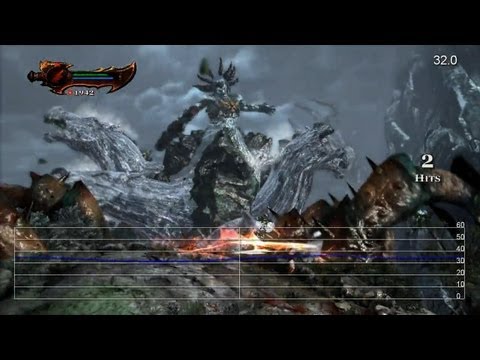
God of War 3's first 30 minutes undoubtedly remains one of the most breathtaking visual spectacles of the current-gen era - and testament to the power of the PlayStation 3 in the right hands.
"At E3, the SPU code for shadows was literally turned on the night before - no joke - so dramatic quality and performance improvements were made from then until we shipped. Many effects such as depth-of-field, motion blur, crepuscular 'god' rays and refraction were either added or improved in quality and speed," says Diamand.
"A number of culling improvements were made and portions of code got moved to the SPUs towards the end to ease the load on the CPU. We also ran a very expensive tools pass on many of our shaders, trying to eke out a few more cycles. Among the more dramatic things on the art side was the addition of proper - more or less - high-dynamic range (HDR), bloom, and tone mapping."
However, despite a warm reception at the crucial E3 conference, not everyone in attendance was enamoured with the results. Certainly the fight with Helios was impressive, but less than stellar feedback on some design choices made the developers think about how to fine-tune the visuals still further.
"I recall one person describing it as if the screen were smeared with a bit of Vaseline, which was a bit of a kick in the pants, and made me redouble efforts in that area," Diamand shares. "When HDR went in, the artists could do true exposure adjustment and could create lights with real range to them. And while the artists did a great job with it, it was really in God of War: Ascension that they perfected their material and lighting usage."
Three years on, God of War: Ascension shows how this drive to continually add new tools and push back boundaries carried straight over from the third game's development. To broaden the creative palette of the studio's many graphics designers, more advanced tools for texturing the environments received special attention.
The rise of God of War: Ascension
"One of the big takeaways [from God of War 3] was that the limits imposed by the engine (to ensure good performance) were restricting artist creativity, so we tried to remove or push those limits as far as possible without losing any performance. One example is the number of UV sets we allowed. We pushed it to three UV sets per mesh," Cedric Perthuis says, referring to a form of texture mapping used to wrap around specific shapes in the geometry. For complex character models such as Kratos, independent textures are needed for body parts unique to him, each wrapping around the head, torso and limbs - all of which form an editable "UV set" when laid out flat.
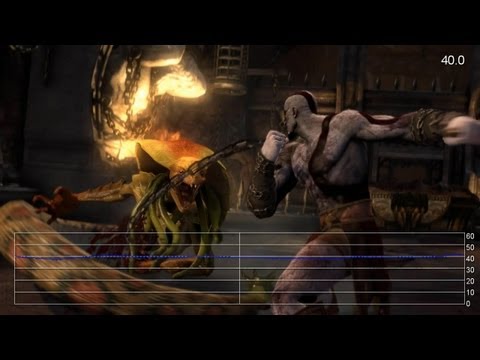
God of War: Ascension incorporates significant enhancements to the Sony Santa Monica engine, specifically in terms of detailing, lighting and effects work.
Allowing multiple UV sets for the surrounding environment, however, also makes it possible to develop a far richer, more natural look to cracked mountain-sides and mossy cavern walls. According to Pethuis, this turns out to be a bit more expensive in terms of data size and vertex input bandwidth for the PS3 hardware, but the results are clearly worth it.
"With this we could now add layers of debris, dirt or grass and make those layers span smoothly across several geometries, while previously we had to add extra transparent meshes going across multiple other meshes, which wasn't always giving good results and could be fairly expensive too," he says.
"Pretty much every system saw its limits pushed," Perthuis adds, highlighting how other engine changes doubled or tripled the number of game objects the engine could handle. He also describes how the organic look of the environments has a basis in its more sophisticated "procedural mesh deformation for foliage and herbs, influenced by wind and collision."
However, even with such improvements in place, the sense of pushing back the frontiers on PS3 didn't feel as pronounced this time around as it was during the development of God of War 3 - something the team are ready to admit.
"From a graphics 'technical' perspective, to a large degree God of War: Ascension was more refinement on the graphics front," Diamand confirms, highlighting that his focus over the last three years has been "less in making whizz-bang graphics improvements, and instead doing a ton of optimization work."
Even so, the changes beyond the back-end are still legion, with "shadows, many more models, more geometry, and significantly more use of multilayer shader features and effects" standing as the key areas of advancement.
"I thought we hit 11 in God of War, but Ascension belies that. Ascension also has more game systems competing for CPU and SPU time. A tremendous amount of time was spent under the hood, optimizing systems and moving even more of the engine to the SPU."
MORE
As we reach the end of the current-gen console era, it's safe to say that it is the difficult, flawed, but ambitious PlayStation 3 that has offered up the most technologically advanced console games of the age. The complex hardware set-up may have banjaxed even the best third-party developers in its early years, but PS3 owners have been spoiled by a range of state-of-the-art gaming epics from Sony's own in-house studios - foremost amongst them, God of War creator Sony Santa Monica.
God of War 3 was a watershed moment in the history of the PlayStation 3. At the time, few believed that Naughty Dog's Uncharted 2 could be matched or even bettered in terms of sheer technological accomplishment, but Kratos' PS3 debut raised the stakes still further. The third game's legendary titan boss set-pieces looked and played with an almost CG-like level of polish, astonishing many with its breathtaking per-pixel lighting, rich detailing and pristine motion blur effects. The sheer scale of ambition on display here was simply breathtaking and even today, God of War 3 ranks as one of the best platform exclusives on the market.
The evolution of God of War 3 - especially from its E3 2009 debut to its March release the following year - remains one of the most dramatic transformations we've seen from preview code to release, and stands as testament to a remarkable era where PS3 game development progressed in colossal leaps and bounds. But understandably, the Sony Santa Monica team look back on this time a little more pragmatically.
"After E3 we had a big back-log of optimisation opportunities and ideas that we wanted to try, and optimisation finally became one of our primary foci. We also doubled the graphics engineering team just around E3," recalls Santa Monica Studio's graphics engineer Cedric Perthuis.
Fellow graphics engineer Ben Diamand also confirms it was a hectic spell for the studio after the unveiling, and many tweaks in the build-up to the game's release came down to the wire. "There were so many major technical improvements that went in between E3 and shipping," he says. "Morphological anti-aliasing (MLAA) got added which improved edges dramatically and saved substantial amounts of frame-rate."
The MLAA technology represented a break-through for developers at the time. Developed by SCEE's own Advanced Technology Group (ATG), it's now a popular edge-detection process that can cost-effectively remove jagged edges from each frame - one of a range of GPU tasks that were hived off to the Cell processor's surrounding Synergistic Processing Units (SPUs). Crucially, for Santa Monica Studio's effects artists, this freed up processing cycles and allowed them to add to the spectacle in other ways.
God of War 3's first 30 minutes undoubtedly remains one of the most breathtaking visual spectacles of the current-gen era - and testament to the power of the PlayStation 3 in the right hands.
"At E3, the SPU code for shadows was literally turned on the night before - no joke - so dramatic quality and performance improvements were made from then until we shipped. Many effects such as depth-of-field, motion blur, crepuscular 'god' rays and refraction were either added or improved in quality and speed," says Diamand.
"A number of culling improvements were made and portions of code got moved to the SPUs towards the end to ease the load on the CPU. We also ran a very expensive tools pass on many of our shaders, trying to eke out a few more cycles. Among the more dramatic things on the art side was the addition of proper - more or less - high-dynamic range (HDR), bloom, and tone mapping."
However, despite a warm reception at the crucial E3 conference, not everyone in attendance was enamoured with the results. Certainly the fight with Helios was impressive, but less than stellar feedback on some design choices made the developers think about how to fine-tune the visuals still further.
"I recall one person describing it as if the screen were smeared with a bit of Vaseline, which was a bit of a kick in the pants, and made me redouble efforts in that area," Diamand shares. "When HDR went in, the artists could do true exposure adjustment and could create lights with real range to them. And while the artists did a great job with it, it was really in God of War: Ascension that they perfected their material and lighting usage."
Three years on, God of War: Ascension shows how this drive to continually add new tools and push back boundaries carried straight over from the third game's development. To broaden the creative palette of the studio's many graphics designers, more advanced tools for texturing the environments received special attention.
The rise of God of War: Ascension
"One of the big takeaways [from God of War 3] was that the limits imposed by the engine (to ensure good performance) were restricting artist creativity, so we tried to remove or push those limits as far as possible without losing any performance. One example is the number of UV sets we allowed. We pushed it to three UV sets per mesh," Cedric Perthuis says, referring to a form of texture mapping used to wrap around specific shapes in the geometry. For complex character models such as Kratos, independent textures are needed for body parts unique to him, each wrapping around the head, torso and limbs - all of which form an editable "UV set" when laid out flat.
God of War: Ascension incorporates significant enhancements to the Sony Santa Monica engine, specifically in terms of detailing, lighting and effects work.
Allowing multiple UV sets for the surrounding environment, however, also makes it possible to develop a far richer, more natural look to cracked mountain-sides and mossy cavern walls. According to Pethuis, this turns out to be a bit more expensive in terms of data size and vertex input bandwidth for the PS3 hardware, but the results are clearly worth it.
"With this we could now add layers of debris, dirt or grass and make those layers span smoothly across several geometries, while previously we had to add extra transparent meshes going across multiple other meshes, which wasn't always giving good results and could be fairly expensive too," he says.
"Pretty much every system saw its limits pushed," Perthuis adds, highlighting how other engine changes doubled or tripled the number of game objects the engine could handle. He also describes how the organic look of the environments has a basis in its more sophisticated "procedural mesh deformation for foliage and herbs, influenced by wind and collision."
However, even with such improvements in place, the sense of pushing back the frontiers on PS3 didn't feel as pronounced this time around as it was during the development of God of War 3 - something the team are ready to admit.
"From a graphics 'technical' perspective, to a large degree God of War: Ascension was more refinement on the graphics front," Diamand confirms, highlighting that his focus over the last three years has been "less in making whizz-bang graphics improvements, and instead doing a ton of optimization work."
Even so, the changes beyond the back-end are still legion, with "shadows, many more models, more geometry, and significantly more use of multilayer shader features and effects" standing as the key areas of advancement.
"I thought we hit 11 in God of War, but Ascension belies that. Ascension also has more game systems competing for CPU and SPU time. A tremendous amount of time was spent under the hood, optimizing systems and moving even more of the engine to the SPU."
MORE