 Tweet
Tweet
A new report released Monday says ad blocking will cost online businesses nearly $22 billion worldwide, and it will only get worse in the coming years.
By Ian Paul

Ad-blocking software is on the rise, and it's no surprise why. People are fed up with advertising networks that track you across the Internet and sites littered with ads. Ad-blocking software helps users reclaim their privacy and enjoy a calmer Internet browsing experience.
Blocking too many ads, though, can starve the very sites users visit. A new report released Monday says ad blocking will cost online businesses nearly $22 billion worldwide, and it will only get worse in the coming years. By 2016 ad blockers are expected to result in an estimated loss of $20.3 billion in the U.S. alone.
Adobe teamed up with Ireland-based start-up PageFair to assess the current use of ad-blocking software. For online sites that rely on advertising, including this one, the future appears to be full of challenges.
Adobe/PageFair
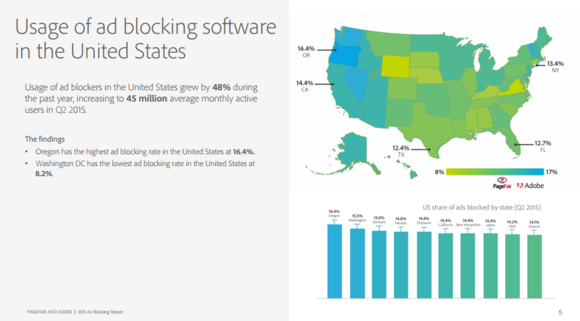
In the United States — one of the most important markets for advertisers — the use of ad-blocking software grew by 48 percent over the past year, reaching an average of 45 million active monthly users between April and June. According to the report, that means 16 percent of the U.S. online population blocked ads during the spring and early summer.
The sites hardest hit by ad-blocking software are ones that attract a young, tech-savvy audience, or have a more male audience. The report specifically calls out visitors to gaming sites as those who are “significantly more likely to block advertising.” Meanwhile, regular visitors to health, charity, and government sites are the least likely to block ads.
Why this matters:
Site publishers are in a bit of pickle right now. They depend on advertising that is offering declining returns, thus requiring increasing amounts of ads to make up the difference. At the same time, site visitors install ad blockers to deal with the increase in ads and prevent advertising networks from tracking them across the web. But if too many people block ads those sites will end up starved for funding. The challenge is to find a happy medium between acceptable types of advertising and returns that will pay staff and server costs.
Mobile blocking on the horizon
The ad-blocking trend is poised to get worse as it moves to mobile platforms. Right now, mobile ad blocking is an insignificant part of the ad blocking world, the report says. It’s possible to block ads on Android, thanks to the AdBlock Plus app and browser, as well as the AdBlock extension on Firefox for mobile.
On iOS, however, ad blocking could get much bigger once iOS 9 rolls out with the Safari Content Blockers feature. This will allow users to install ad blockers for Safari on iOS — once developers build them.
If iOS users turn to ad blockers in droves, that will have a significant impact on ad-based online revenue, especially in the U.S., where iOS makes up 44 percent of smartphone market share, according to comScore.
While iOS may be the ad-blocking platform of the future, right now Google Chrome is the browser of choice for ad-blocking users, according to the Adobe and PageFair report. That’s ironic considering a large portion of Google’s income relies on web-based ads.
By Ian Paul
Ad-blocking software is on the rise, and it's no surprise why. People are fed up with advertising networks that track you across the Internet and sites littered with ads. Ad-blocking software helps users reclaim their privacy and enjoy a calmer Internet browsing experience.
Blocking too many ads, though, can starve the very sites users visit. A new report released Monday says ad blocking will cost online businesses nearly $22 billion worldwide, and it will only get worse in the coming years. By 2016 ad blockers are expected to result in an estimated loss of $20.3 billion in the U.S. alone.
Adobe teamed up with Ireland-based start-up PageFair to assess the current use of ad-blocking software. For online sites that rely on advertising, including this one, the future appears to be full of challenges.

Adobe/PageFair
In the United States — one of the most important markets for advertisers — the use of ad-blocking software grew by 48 percent over the past year, reaching an average of 45 million active monthly users between April and June. According to the report, that means 16 percent of the U.S. online population blocked ads during the spring and early summer.
The sites hardest hit by ad-blocking software are ones that attract a young, tech-savvy audience, or have a more male audience. The report specifically calls out visitors to gaming sites as those who are “significantly more likely to block advertising.” Meanwhile, regular visitors to health, charity, and government sites are the least likely to block ads.
Why this matters:
Site publishers are in a bit of pickle right now. They depend on advertising that is offering declining returns, thus requiring increasing amounts of ads to make up the difference. At the same time, site visitors install ad blockers to deal with the increase in ads and prevent advertising networks from tracking them across the web. But if too many people block ads those sites will end up starved for funding. The challenge is to find a happy medium between acceptable types of advertising and returns that will pay staff and server costs.
Mobile blocking on the horizon
The ad-blocking trend is poised to get worse as it moves to mobile platforms. Right now, mobile ad blocking is an insignificant part of the ad blocking world, the report says. It’s possible to block ads on Android, thanks to the AdBlock Plus app and browser, as well as the AdBlock extension on Firefox for mobile.
On iOS, however, ad blocking could get much bigger once iOS 9 rolls out with the Safari Content Blockers feature. This will allow users to install ad blockers for Safari on iOS — once developers build them.
If iOS users turn to ad blockers in droves, that will have a significant impact on ad-based online revenue, especially in the U.S., where iOS makes up 44 percent of smartphone market share, according to comScore.
While iOS may be the ad-blocking platform of the future, right now Google Chrome is the browser of choice for ad-blocking users, according to the Adobe and PageFair report. That’s ironic considering a large portion of Google’s income relies on web-based ads.


Comment