Announcement

Collapse
No announcement yet.

Corinthian Colleges shuts down remaining 28 campuses

Collapse
X
 
  • Filter
  • Time
  • Show
Clear All
new posts

  • Corinthian Colleges shuts down remaining 28 campuses

    By Laura Mandaro


    This photo taken July 8, 2014 shows a person walking past an Everest Institute sign in a office building in Silver Spring, Md. (Photo: AP Photo/Jose Luis Magana)

    For-profit college provider Corinthian Colleges said Sunday it had ceased nearly all operations and had stopped instruction at its remaining 28 physical campuses.

    The decision affects students at its Heald College system, including 10 locations in California, one in Oregon, and one in Hawaii, as well as other campuses under the Everest or WyoTech names in California, Arizona and New York.

    The Santa Ana, Calif. based company said it is working to provide continuing educational opportunities for its 16,000 students, but it will depend on regulators and education partners.

    The decision follows a July agreement with the U.S. Department of Education to sell or wind down all of its schools after the DOE had placed a temporary hold on Corinthian's access to federal student loan funds over concerns it had allegedly falsified graduates' job placement rates.

    Earlier this month, the DOE said a review found hundreds of cases of misrepresentation of job placement rates to current and prospective students in Corinthian's Heald College system. The DOE said it would fine the company $30 million.

    The Obama administration, U.S. regulators and state officials have targeted the for-profit college sector with suits and investigations, charging some with aggressively marketing services and high-cost loans to students who couldn't afford to pay them back, particularly given the schools' low graduation rates.

    The school operators have said they provide opportunities to career-minded students who otherwise might not get any higher education.

    "We believe that we have attempted to do everything within our power to provide a quality education and an opportunity for a better future for our students," said Jack Massimino, Chief Executive Officer of Corinthian, in a statement. "We made every effort to address regulators' concerns in good faith."

    While Corinthian had announced last year it would sell or shut down its more-than 90 physical campuses, Sunday's decision took some students by surprise.

    "A lot of us are devastated," Dylan Low, 22, toldThe Los Angeles Times. He had been pursuing a criminal justice associate's degree at Everest College-Ontario, near Los Angeles, and had three more classes to finish before his July graduation, according to the newspaper.
    The Hackmaster

  • #2
    Government To Forgive Student Loans At Corinthian Colleges

    Posted by Little Dawn

    New York Times:

    Mr. Duncan also said the department planned to develop a process to allow any student — whether from Corinthian or elsewhere — to be forgiven their loans if they had been defrauded by their colleges. A special master would be appointed within three weeks, department officials said, to create procedures to apply for relief that are “durable, not just for Corinthian but beyond.”
    Previously, previouslier.

    College Inc. [PBS 05/04/10]

    Kaplan Higher Ed settles lawsuit, government investigations [Sun Sentinel 07/26/11]

    For-Profit College Group Sued as U.S. Lays Out Wide Fraud [NYT 08/08/11]

    For-profit colleges see jump in lawsuits from former students alleging fraud [Kansas City Business Journal 09/30/11]

    Enrollments tumble at for-profit colleges [Inside HigherEd 11/11/11]

    For Profit Higher Education: The Failure to Safeguard the Federal Investment and Ensure Student Success [U.S. Senate 07/30/12]

    Beauty School Students Left With Broken Promises and Large Debts [NYT 07/28/13]

    For-profit colleges: Prospective students need to approach them with eyes wide open [MinnPost 11/20/13]

    Argosy University agrees to pay $3.3M to settle case filed by Colorado's Attorney General Office [Denver Channel 12/05/13]

    How a For-Profit College Can Fake Good Job Placement [Washington Monthly 12/20/13]

    Inspecting a Student Loan Spigot [NYT 01/18/14]

    "I feel like I was set up to fail": Inside a for-profit college nightmare [Salon 01/25/14] (previously)

    Screw U: How For-Profit Colleges Rip You Off [Mother Jones 01/31/14]

    Federal Lawsuit Accused For-Profit Schools of Fraud [NYT 02/19/14]

    College, the Great Unleveler [NYT 03/01/14]

    Students file lawsuit against Wright Career College [Fox4kc 03/05/14]

    The rise and fall of Corinthian Colleges and the wake of debt it left behind [Guardian 07/28/14]

    The investment in for-profit colleges isn't paying off [WaPo 09/25/14]
    The Hackmaster

    Comment


    • #3
      Why Do I Keep Seeing Commercials For Everest University?

      By Ashlee Kieler


      Commercials for Everest University continue to appear on TV, because the schools are now operated by Zenith Education Corp.

      If you’re sitting at home watching television on any given afternoon, you’re likely to see a few commercials touting the supposed convenience and benefits of attending a for-profit college. But with the recent, very public collapse of now-bankrupt Corinthian Colleges Inc — and the closure of many of its schools — you might be wondering why your Jerry Springer show is being interrupted with ads for Everest University.

      That’s because, if you remember, another company – Education Credit Management Corporation – swooped in to purchased 56 Everest and WyoTech campuses in various parts of the country, just two months before CCI’s remaining Everest, Heald College and Wyotech campuses were closed.

      When ECMC revealed its plans to purchase the beleaguered for-profit brands, it announced it would run the schools under its new Zenith Education Group division and transition them from for-profit to nonprofit status.

      Additionally, the company said it would create a program to eliminate some of the schools worst performing programs and remove binding, mandatory arbitration from enrollment agreements.

      Despite these changes, the commercials for the new Everest are remarkably similar and give the impression that things are business as usual, as one reader tells Consumerist.

      On a recent afternoon at his home in the Northwest U.S. our reader saw a “familiar Everest ad, the one with the young, nervous appearing, woman.”

      While our reader was right to think that it was odd for a company that had closed to continue advertising, it turns out the Everest schools in his area are actually continuing to operate under the Zenith Education Group.

      That only brings up the question: If your company spent $24 million to buy schools with a brand name synonymous with inflated graduation rates, federal investigations and unfair business practices, wouldn’t you maybe change the moniker and branding?

      One might think that would be the logical step for a corporation, but it’s not always economically feasible. And that’s apparently the case with ECMC/Zenith and the Everest and WyoTech schools it purchased.

      Dave Hawn, President and CEO of ECMC Group and Interim President and CEO of Zenith Education Group, tells Consumerist in a statement that the company understands consumers’ confusion about what schools have closed and which remain open under Zenith leadership.

      To be clear, there are currently 46 Everest University campuses and three WyoTech campuses still operating, while another seven Everest schools are on a teach-out program, meaning they are no longer enrolling new students.

      “Although we considered rebranding, it would be a lengthy and expensive process for more than 45 schools, and we would rather invest those funds in programs that directly support student success,” Hawn says.

      But it wasn’t all about the money, he says. In fact, he contends that keeping the name has made it easier for students.

      “Keeping the Everest name helped minimize disruption for existing students when we assumed ownership of the schools,” he says. “Ultimately, we believe that Zenith’s system-wide focus on student completion and graduate placement, as well as our tuition reductions and grant programs for students in financial need, will help create positive awareness of our schools.”

      So it doesn’t appear that Zenith is worried about any kind of negative connotation that might be attached to the Everest or WyoTech names – familiar commercials or not.
      The Hackmaster

      Comment


      • #4
        Disgraced For Profit Colleges Tricked Students, But Government Delays Relief

        Corinthian Colleges students who were duped into federal student loans face more hurdles before their debts can be canceled.

        By Shahien Nasiripour


        Teachers line up to enter for a meeting and opportunity to collect their personal items at Everest College in City of Industry, one of the Corinthian Colleges that closed on Monday. April 27th, 2015. (Al Seib/Los Angeles Times via Getty Images)

        Corinthian Colleges Inc., the defunct for-profit chain of schools, may have duped 85,000 students into enrolling by advertising false job placement rates, the U.S. Department of Education said Tuesday.

        The declaration, the result of the department's review of internal company records and evidence obtained by California Attorney General Kamala Harris, may make it easier for some student debtors who attended Corinthian's Everest and Wyotech schools in California, or took classes from Everest's Florida-based online program, to petition the Education Department to cancel their debts. Federal law contains a provision aimed at shielding borrowers from making payments on federal student loans granted on fraudulent conditions.

        The Education Department said it found startling discrepancies between what Corinthian reported about former students' employment and the truth. For example, at the Everest location in West Los Angeles, the school told prospective students of its associate-level paralegal program that 60 percent of former students got jobs in their fields. The actual rate was 0. Harris sued Corinthian in 2013.

        But Education Secretary Arne Duncan isn't automatically discharging defrauded students' debts, despite pleas from some prominent state and federal officials, including Harris. Instead, the Education Department is requiring defrauded students to complete application forms.

        Department officials promised an expedited process for these 85,000 borrowers, but it made a similar promise earlier this year to the roughly 40,000 former Corinthian students who attended the company's Heald schools. Those students allegedly were systematically misled about Heald's job placement rates. The Education Department has made "significant progress" in reviewing borrowers' debt relief claims, Undersecretary Ted Mitchell said.

        Lawyers for some low-income borrowers have said the process penalizes those who either don't know they're eligible for debt relief or lack access to computers or lawyers. In situations where the Education Department has ample evidence of fraud, such as in the Corinthian case, Duncan should simply use his authority to dismiss borrowers' obligation to repay, advocates say.

        "Our goal is to ensure that every eligible student receives every penny of the debt relief they are entitled to as efficiently and easily as possible," said John B. King Jr., who will take over as education secretary when Duncan steps down next month.

        The Education Department's refusal to automatically cancel debts allows it to save a portion of the $690 million that it would have to write off. It also makes defrauded borrowers more reliant on the Education Department's loan contractors, which counsel borrowers on repayment options and collect their monthly payments.

        Loan servicers such as Navient Corp., the student loan giant formerly known as Sallie Mae, are borrowers' primary point of contact when they have issues with their federal student loans.

        The Education Department is doing a terrible job overseeing them and making sure they're not misleading borrowers, according to prepared remarks an official at the U.S. Government Accountability Office plans to deliver to Congress on Wednesday.

        Federal Student Aid, the Education Department unit responsible for the $1.2 trillion federal student loan program, doesn't adequately monitor how its loan servicers interact with borrowers, according to prepared remarks by Melissa Emrey-Arras of GAO.

        Reviews of random call recordings are often incomplete or contain inaccurate information, according to Emrey-Arras. Reports on the reviews don't routinely detail the severity of servicers' errors or make clear whether servicers gave borrowers false information about loan repayment plans. The reports also "do not reflect the actual prevalence of particular problems in the calls the agency monitors." FSA doesn't even verify that its servicers actually hand over a random sample of calls for it to review, according to Emrey-Arras.

        "FSA is missing opportunities to target its oversight and improve services to borrowers," Emrey-Arras said in the remarks.

        Kathleen Tighe, the Education Department's inspector general, plans to tell Congress that after years of her investigators repeatedly discovering failures in how FSA oversees schools and contractors that participate in the federal student aid program, it may be time for Congress to beef up its own requirements of FSA.

        Corinthian Colleges had been under the Education Department's close watch since August 2012, the department said Tuesday. Yet the government missed Corinthian's alleged deceptions for years.
        The Hackmaster

        Comment


        • #5
          Trouble remains following failed for profit schools revival

          By Jeff Horwitz


          In this March 11, 2016 photo, Shane Satterfield, a roofer who owes more than $30,000 in debt for an associate’s degree in computer science from one of the country’s largest for-profit college companies that failed in 2014, holds his diploma in Atlanta. "I graduated in April at the top of my class, with honors," says Satterfield. "And I can’t get a job paying over $8.50 an hour." Despite pledging to distance itself from the poor business practices of the for-profit Corinthian Colleges Inc, the new owner of the Everest career college chain has retained key members of its staff and some of its hard-charging sales tactics.


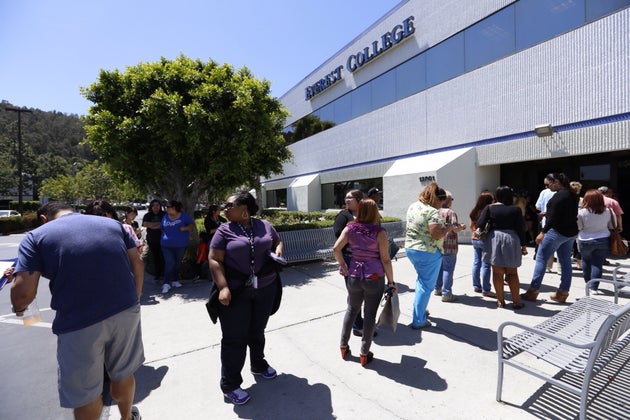
          In this April 28, 2015, file photo, students wait outside Everest College in Industry, Calif., hoping to get their transcriptions and information on loan forgiveness and transferring credits to other schools.

          WASHINGTON (AP) — When one of the country's largest for-profit college companies failed in 2014, the Education Department faced a choice. It could shut down Corinthian Colleges Inc., incurring a $1 billion loss to taxpayers and sending students scrambling, or it could find someone to take the school off its hands.

          With a history of fraud discovered by auditors and investigators, and poor outcomes for students, the company drew only one interested buyer: a student loan debt collection firm that had formed a nonprofit educational company called Zenith Education Group.

          A little over one year after Zenith took the helm, a review of the school's operations by The Associated Press shows that despite ostensibly new oversight by the Obama administration, the business model for what had been a failing chain of career training schools hasn't fundamentally changed.

          The Education Department has permitted Zenith, the new owners, to recruit students using large-scale telemarketing and paid media campaigns that sometimes advertise programs that no longer exist. Executives who formerly oversaw Corinthian's business practices, which state and federal officials said were fraudulent, remain employed at Zenith.

          As with Corinthian, Zenith still requires students to waive their right to sue the school in a class action — a legal power play unheard of among traditional colleges. Zenith continues to recruit students using the very same ads that Corinthian ran during the very same daytime TV talk shows.

          Ominously for students and the government, recent graduates told the AP they are struggling to find work that would allow them to pay back their student loans. That raises the prospect the U.S. is seeding a new crop of loan defaults.

          "I graduated in April at the top of my class, with honors," said Shane Satterfield, a roofer in Georgia who now owes more than $30,000 in debt for the associate's degree in computer science he completed last year. "And I can't get a job paying over $8.50 an hour."

          The mess of how to deal with Zenith and its struggling for-profit former peers is among the most serious problems confronting the Education Department and its new leadership. John B. King Jr., who was expected to win Senate confirmation late Monday as education secretary, was hired as an adviser in January 2015, after the department had set Zenith's path under then-Secretary Arne Duncan.

          Zenith chairman David Hawn said some marketing practices the AP identified were problematic, and he acknowledged that graduates are not yet coming out of the school with key credentials for getting a job. But he said the schools were on the right track.

          "We are spending a lot of money to right the ship," Hawn said. He added that Zenith had shrunk — it is down to about 15,000 students — and lost more than $100 million in its first year and expects to lose money again in its second. "Every step we're taking is in support of our quest to become a really great career school," he said.

          Corinthian's failure gave the administration unprecedented say in its relaunch.

          "The Department of Education sold these schools to a firm that had no experience in providing education and insufficient motivation to genuinely fix the business model," said David Halperin, a Washington lawyer and consumer advocate who helped identify problems at Corinthian. "It would have been better to help existing students find new opportunities elsewhere."

          Education Department Undersecretary Ted Mitchell, who oversees colleges and vocational schools, said the government was raising AP's findings with Zenith. "The fact is that we were able with Zenith to provide a plan for tens of thousands to move on," he said. "If Zenith is not doing right by its students, we won't hesitate to act."

          Though the timing of Corinthian's collapse was a surprise, the reasons for it were not:

          —A January 2011 whistle blower lawsuit alleged that Corinthian employees routinely fabricated employers to make it appear that unemployed graduates had landed good jobs in their chosen careers.

          —A July 2012 report by the Senate Health, Education, Labor and Pensions committee found that more than half of Corinthian students dropped out.

          —Undercover investigators at the Government Accountability Office enrolled in Everest, Corinthian's flagship among its schools, and received passing grades for obviously plagiarized or incorrect assignments.

          —A lawsuit by California's attorney general, filed in 2013 and amended in 2014, alleged rampant lying to students about job placement and cited internal marketing documents that identified Corinthian's best prospects as people with "low self-esteem" who have "few people in their lives that care about them." That case is pending.

          Despite the misconduct allegations, the Education Department didn't cut off the hundreds of millions in student loan dollars it was channeling to Corinthian. The harshest punishment the department imposed was a 3 week hold on payments in June 2014. The temporary delay in loan disbursements led to Corinthian's abrupt collapse.

          The financial failure left the department in a nasty position. After years of payouts to investors and multi-million dollar bonuses for its executives, Corinthian had few assets, 70,000 students and massive legal trouble.

          Simply allowing Corinthian to fold would have forced the U.S. government to absorb hundreds of millions of dollars in losses on student loans and put students on the street. Keeping the schools alive would save the government from much of the damage. But given the depth of the legal and financial troubles, suitors were scarce.

          "There was this strong sense, from the media communications standpoint, where they said 'Do we really want all these students getting thrown out of school,'" said Robert Shireman, a former deputy undersecretary who left the department in 2010. "Somewhere in there, someone came up with ECMC," Education Credit Management Corp., the nonprofit student debt collection company based in Oakdale, Minnesota, that controls Zenith.

          When Zenith Education Group acquired the remains of Corinthian, its executives knew what they were getting.

          Zenith's schools, the company wrote, had a culture of "accepting anyone with a pulse." A large portion of the student body was "at risk," and Corinthian had defrauded students through false promises of future employment and deprived them of a functional education, it said. In a way reminiscent of the subprime mortgage crisis, Zenith said Corinthian had walked off with money from government-backed loans and left everyone else in the lurch.

          A year later, the school has lowered tuition by 20 percent and shuttered some career programs with the worst student outcomes. Aside from these changes, Zenith's flagship Everest University is operating largely according to Corinthian's for-profit business model.

          Many of Corinthian's senior regulatory and compliance officials stayed on board. Zenith's deputy general counsel and its corporate counsel came from Corinthian. Also still at Zenith are executives who oversaw Corinthian's accreditation, student finance operations and its hard-charging recruitment call centers.

          The longtime director of compliance and program management at Corinthian, Susan Samek, now oversees job placement verification. That role requires her to ensure that Everest is no longer lying to the government or its students about placement rates, which Zenith acknowledged had happened.

          Some Zenith executives have altered their social media profiles in ways that obscure details of their earlier work with Corinthian. In October, shortly after Hawn disputed in an interview that Zenith Deputy General Counsel Diana Scherer had handled regulatory compliance at Corinthian, her LinkedIn profile was edited to remove mention of that work.

          Hawn said that just because Zenith compliance employees had also held senior positions at Corinthian does not mean they will repeat that organization's mistakes.

          "Compliance matters to us in a big way," he said. He said the compliance department ultimately reports to people employed by Zenith. As for the holdover employees, he said, "I'm proud they're serving alongside us."

          Zenith has retained Corinthian's policy of prohibiting its students from suing it in class actions. Under Corinthian, students were required to sign waivers giving up their right to sue over misconduct at the school; their only option was arbitration. At the Education Department's insistence, Zenith dropped the across-the-board ban on lawsuits. But Zenith still requires students to sign a ban on class actions, which are generally regarded as an effective way to pursue a large number of cases.

          Such a ban is virtually unprecedented at nonprofit colleges, but Hawn said that Zenith will keep it for now despite what he said were few student complaints.

          "Arbitration, that's a much better remedy," Hawn said. "As our confidence grows in our ability to serve our students well, we will continue to look at the class-action lawsuit issue."

          The Education Department's Mitchell said the government wants Zenith to lift its class-action ban. Though the Department cannot simply mandate that Zenith drop it, the government proposed rules late Friday afternoon that would bar colleges at large from restricting students' right to sue.

          Recruiting at Zenith still bears echoes of the hard-sell tactics of its predecessor.

          Under a government agreement, Zenith hired a law firm to review its operations and monitor its progress. Samples of recruitment calls from Zenith's call centers found that 11 percent of student contacts in November for Everest's physical campuses contained statements that merited review, including unsubstantiated statements about Everest's tuition, the likelihood of graduates finding jobs, child care options for students and the ability to transfer Everest's credits to other schools.

          In practice, Everest's credits are usually not transferable. Under Zenith, an addendum to Everest's enrollment agreement said credits "will probably not be transferable to a college or university" and that an Everest degree "will probably not serve as a basis for obtaining a higher level degree at a college or university."

          When an AP reporter inquired about taking classes, Everest admissions staff would not discuss the likelihood of credit transfers, saying only that a student's future university of choice would determine that. Separately, an AP reporter briefly registered last summer for classes at Everest in computer science to get a first hand impression of Zenith's operations, and then withdrew during a trial period before the bill of about $3,500 came due.

          Zenith has a board of directors that is supposed to keep an eye on governance of its schools. But in an unusual move for a nonprofit educational institution, those board members receive salaries of between $84,000 and $142,000 a year for working between seven hours to 19 hours each week. The money flows through Zenith's parent, ECMC, and not directly from Zenith's budget.

          "When a nonprofit board is paid, those people are consultants," Shireman said. He said such board members would have little incentive to act in ways that would harm Zenith's finances. "They are not overseeing the management on behalf of the public."

          The Education Department's Mitchell also faulted the arrangement.

          "The proper governance of education requires an independent board," he told the AP. "I'm personally disappointed that they haven't moved more quickly on this."

          Current students and recent Everest graduates gave mixed reviews to Zenith. Some said they would recommend Everest to friends. But most expressed disappointment and disillusionment. None reported seeing major changes in their curriculum. Hawn said that such things take time. He expects to roll out the introduction of more employer-recognized professional certifications late this year.

          "Do we have programs today that need work? Frankly, every one of them does," Hawn said. "But that's why we're doing what we're doing."

          Among its faculty, some of Everest's online instructors have substantial professional experience in their fields and many are adjunct faculty shared with for-profit online colleges. A few professors' entire post-secondary education has occurred at for-profit online schools.

          Despite telling the AP last October it wanted to recruit students more selectively, Zenith has continued to run the same ads Corinthian produced. The TV spots — featuring quick cuts and a high tempo musical background — portray Everest as a fast track to a solid paying job and even buying a house. One includes actors explaining why Everest is better than community college, which is almost always a more affordable educational option.

          Everest spent roughly $11.5 million last year on national television ads, according to data provided by iSpot.tv, a media tracking firm. Most were ads Corinthian created. That spending disproportionately focused on daytime TV talk shows with such hosts as Maury Povich, Steve Wilkos and Jerry Springer — shows whose audiences skewed toward the young, black and poor.

          Everest also has prospected for students by advertising programs that didn't exist.

          When Zenith took control of Everest, it shut down the school's online paralegal program as a result of its terrible track record, but continued to advertise the program on its website, in paid search ads and in correspondence with prospective students. In conversations with Everest's admissions team, recruiters repeatedly tried to suggest enrolling in other programs.

          Everest plans to bring back a version of the online paralegal program later this spring, Hawn said, and only began advertising for it in last month. The AP found Everest advertising for the canceled program in November, four months ago.

          Similarly, Everest's online marketing materials continued to promote associates degrees in criminal justice and homeland security, programs that have been permanently phased out.

          "It's not OK to advertise something we don't offer," Hawn said. "We've got to insure we don't do that."

          Students who provided what were supposedly recent testimonials about the quality of Everest's online education appear never to have attended Everest, the AP found. They were students more than a decade ago at Florida Metropolitan University, a for-profit school that Everest later bought.

          The AP contacted one of the students, Martine Darby, about whether she had ever endorsed Everest. She said she had not.

          "I would not want my name associated with Everest," Darby told the AP. She was impressed by FMU when she attended, but she ran into trouble years later when she attempted to transfer the credits to Arizona State.

          "I was told that none of my credits from the associate's degree I paid $30,000 for were transferable because the school is not accredited with the appropriate organization," she wrote.

          After the AP asked Zenith about the testimonials, Everest replaced them with a note stating "NEW TESTIMONIALS COMING SOON!"

          "We've addressed that," Hawn said. "That was inappropriate."
          The Hackmaster

          Comment


          • #6
            Another Univ. of California Leader Quits Another For-Profit College Board

            By David Halperin


            Late on Friday, controversial for-profit college company Bridgepoint Education reported in a filing with the Securities and Exchange Commission that Marye Anne Fox, Chancellor Emerita and current Distinguished Professor of Chemistry at the University of California, San Diego, had resigned from the company’s board of directors on Thursday, “effective immediately.” Bridgepoint’s filing says, “Dr. Fox’s decision to resign from the Board was for personal reasons not related to any disagreement with the Company relating to the Company’s operations, policies or practices.”

            If so, the timing was bad.

            On March 1, University of California-Davis’s current chancellor, Linda Katehi, resigned from the board of directors of for-profit college company DeVry Education Group just eight days after joining that board and after a California legislator and public interest organizations had criticized her.

            The Federal Trade Commission had sued DeVry in January for alleged deceptive advertising. The company also has been under investigation by the U.S. Department of Education and the attorneys general of Illinois, Massachusetts, and New York.

            Katehi’s resignation from the DeVry board did not halt the criticisms, especially after it was discovered that she also serves on the board of college textbook publisher John Wiley & Sons. Five California Assembly members have now called on Katehi to resign as chancellor, and students demanding her ouster have been camped out outside her office.

            UCSD’s Fox, who received the National Medal of Science from President Obama in 2010, joined the Bridgepoint board in November 2011 while still the UCSD chancellor, but after she announced that she would step down from that post in 2012.

            In an article on the Katehi controversy earlier this month, the Sacramento Bee noted a 2006 San Diego Union-Tribune report that then-Chancellor Fox was serving as a director for 10 corporations and nonprofit groups; seven of those board positions came with compensation, totaling $410,000 per year. This month’s SacBee report did not note Fox’s subsequent appointment to the Bridgepoint board. But being mentioned in the context of the Katehi controversy perhaps got Fox thinking.

            Fox joined the Bridgepoint board at a time when the company was facing public scrutiny for its questionable business practices. Senator Tom Harkin (D-IA) had begun a broad investigation of the for-profit college industry, and in March 2011 he held a hearing focusing on San Diego-based Bridgepoint. Bridgepoint had taken over a small Catholic college in Clinton, Iowa, for its accreditation, and turned it into largely online school Ashford University.

            At the hearing, Harkin presented a series of charts showing that the company had seen rapid growth, with revenues increasing from $33 million in 2008 to $216 million in 2010, while experiencing mounting student loan default rates.

            Harkin said Bridgepoint was “a scam, an absolute scam ... premised on aggressively recruiting largely low-income, disadvantaged students ... collecting their federal grants and loans even as the vast majority of students drop out ... and lavishly rewarding executives and shareholders with mostly taxpayer dollars.” He concluded, “From a strictly business perspective, this is a highly successful model. But, I must say, from an educational perspective — and, frankly, from an ethical perspective — it is deeply disturbing model.”

            At the time Fox joined the Bridgepoint board later that year, according to a news report at the time, she “did not return a phone call requesting comment on the controversy surrounding Bridgepoint.”

            In the past few years, Bridgepoint has been under investigation for potential fraud by the Securities and Exchange Commission, the Consumer Financial Protection Bureau, and at least five state attorneys general.

            Yet the company has continued to grow, last year receiving $639 million in taxpayer dollars from federal student grants and loans. However, the company’s stock price has dropped from about $30 in mid-2011 to around $10 today.

            When Bridgepoint bought the Iowa college in 2005, and the town expressed concern about the future of the school and the jobs it provided, Ashford’s president promised the Clinton city council, “We will never, ever get rid of the Clinton campus.” Last summer, Ashford announced it was getting rid of the Clinton campus. O_o

            Bridgepoint announced earlier this week that it would “further strengthen the academic leadership of the University through the appointment of Dr. Craig Swenson to president of Ashford University.” Swenson’s predecessor, Richard Pattenaude, joined Bridgepoint in 2012 after serving for five years as chancellor of the University of Maine system. But Swenson’s background is in for-profit education, running EDMC’s Argosy University and then another Bridgepoint school, Denver-based University of the Rockies.

            For-profit colleges with troubling records have frequently brought onto their boards prominent people whose reputations can help validate their institutions with government overseers, accreditors, and the public. One of the worst companies in the sector, now shuttered Corinthian Colleges, added former Secretary of Defense Leon Panetta in 2013; he quit eleven weeks later after criticism from Republic Report and, subsequently, the Los Angeles Times columnist. National Urban League president and former New Orleans mayor Marc Morial, and American Association of Colleges for Teacher Education CEO Sharon Robinson remained on the Corinthian board until the company’s collapse.

            Former U.S. congressman (R-MN) and prominent Washington lobbyist and GOP strategist Vin Weber serves on the board of troubled for-profit college company ITT Educational Services.

            University of Arizona president Ann Weaver Hart, who joined the DeVry board of directors at the same time as UC Davis’s Linda Katehi, has said she is staying on that board.

            This article also appears on Republic Report.
            The Hackmaster

            Comment

            Working...
            X