Announcement

Collapse
No announcement yet.

2nd Largest Health Insurer In The US Hacked

Collapse
X
 
  • Filter
  • Time
  • Show
Clear All
new posts

  • 2nd Largest Health Insurer In The US Hacked

    From the Desk
    of Joseph R. Swedish

    President and CEO Anthem, Inc.

    To Our Members,

    Safeguarding your personal, financial and medical information is one of our top priorities, and because of that, we have state-of-the-art information security systems to protect your data. However, despite our efforts, Anthem was the target of a very sophisticated external cyber attack. These attackers gained unauthorized access to Anthem’s IT system and have obtained personal information from our current and former members such as their names, birthdays, medical ID's/social security numbers, street addresses, email addresses and employment information, including income data. Based on what we know now, there is no evidence that credit card or medical information, such as claims, test results or diagnostic codes were targeted or compromised.

    Once the attack was discovered, Anthem immediately made every effort to close the security vulnerability, contacted the FBI and began fully cooperating with their investigation. Anthem has also retained Mandiant, one of the world’s leading cybersecurity firms, to evaluate our systems and identify solutions based on the evolving landscape.

    Anthem’s own associates’ personal information – including my own – was accessed during this security breach. We join you in your concern and frustration, and I assure you that we are working around the clock to do everything we can to further secure your data.

    Anthem will individually notify current and former members whose information has been accessed. We will provide credit monitoring and identity protection services free of charge so that those who have been affected can have peace of mind. We have created a dedicated website - www.AnthemFacts.com - where members can access information such as frequent questions and answers. We have also established a dedicated toll-free number that both current and former members can call if they have questions related to this incident. That number is: 1-877-263-7995. As we learn more, we will continually update this website and share that information you.

    I want to personally apologize to each of you for what has happened, as I know you expect us to protect your information. We will continue to do everything in our power to make our systems and security processes better and more secure, and hope that we can earn back your trust and confidence in Anthem.

    Sincerely,

    Joe

    Joseph R. Swedish
    President and CEO
    Anthem, Inc.

    Anthem was the target of a very sophisticated external cyber attack. Based on what we know now, there is no evidence that credit card or medical information were targeted or compromised.

    Last edited by dlevere; 02-05-2015, 11:48:46 AM.
    The Hackmaster

  • #2
    Data Breach at Health Insurer Anthem Could Impact Millions

    By Brian Krebs

    Anthem Inc., the nation’s second largest health insurer, disclosed Wednesday that hackers had broken into its servers and stolen Social Security numbers and other personal data from all of its business lines. Given the company’s size, this breach could end up impacting tens of millions of Americans.


    Anthem didn’t specify how many consumer records may have been breached, but it did say all of the company’s business units are affected. The figures from Anthem’s Web site offer a glimpse at just how big this breach could be: “With nearly 69 million people served by its affiliated companies including more than 37 million enrolled in its family of health plans, Anthem is one of the nation’s leading health benefits companies.”

    The company said it is conducting an extensive IT forensic investigation to determine what members are impacted.

    “We are working around the clock to determine how many people have been impacted and will notify all Anthem members who are impacted through a written communication,” Anthem said in question and answer page released about the breach.

    Formerly known as Wellpoint Inc., Anthem said in a statement that the company was the target of a “very sophisticated external cyber attack” that exposed names, dates of birth, member ID/ Social Security numbers, addresses, phone numbers, email addresses and employment information. The company stressed that the exposed data did not include medical records or financial information.

    According to Athem’s statement, the impacted (plan/brands) include Anthem Blue Cross, Anthem Blue Cross and Blue Shield, Blue Cross and Blue Shield of Georgia, Empire Blue Cross and Blue Shield, Amerigroup, Caremore, Unicare, Healthlink, and DeCare. The company said impacted members will receive notice via mail which will advise them of the protections being offered to them as well as any next steps.

    Anthem said once the attack was discovered, the company immediately made every effort to close the security vulnerability, contacted the FBI and began fully cooperating with their investigation.

    More on this story as it develops. Stay tuned.
    The Hackmaster

    Comment


    • #3
      Seriously who gives a flying fuck about your claims or other health data when they have everything else about you to pretty much take your identity and all around tax season, coincidence? maybe but makes me wonder. These places that hold tons of personal info need to get better security because who suffers is us and we can't do shit about it.
      Spoiler Alert! Click to view...

      THE BAD GUY!!!!!!

      Comment


      • #4
        Phishers Pounce on Anthem Breach

        By Brian Krebs

        Phishers and phone fraudsters are capitalizing on public concern over a massive data breach announced this week at health insurance provider Anthem in a bid to steal financial and personal data from consumers.

        The flood of phishing scams was unleashed just hours after Anthem announced publicly that a “very sophisticated cyber attack” on its systems had compromised the Social Security information and other personal details on some 80 million Americans.

        In a question on its FAQ page about whether it would be offering credit monitoring to affected customers, Anthem said "All impacted members will receive notice via mail which will advise them of the protections being offered to them as well as any next steps.”

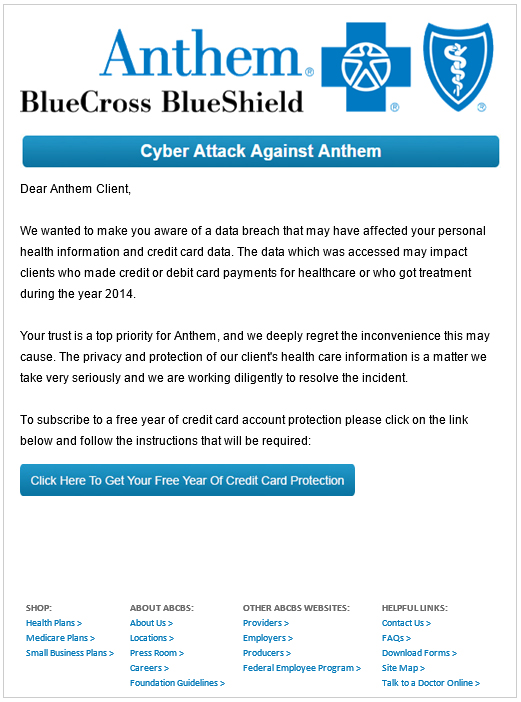
        Unsurprisingly, phishers took that as an invitation to blast out variations on the scam pictured below, which spoofs Anthem and offers recipients a free year’s worth of credit monitoring services for those who click the embedded link.

        Don’t click or respond to these phishing emails.

        According to Anthem, fraudsters also are busy perpetrating similar scams by cold-calling people via telephone. In a recording posted to its toll-free hotline for this breach (877-263-7995), Anthem said it is aware of outbound call scams targeting current and former Anthem members.

        “These emails and calls are not from anthem and no notifications have been sent from anthem since the initial notification on Feb. 4, 2015,” Anthem said in a voice recording on the hotline.

        It is likely that these phishing and phone scams are random and opportunistic, but there is always the possibility that the data stolen from Anthem has fallen into the hands of scam artists. According to Anthem, the information stolen includes the consumer’s name, date of birth, member ID, street address, email address, phone number and employment information.

        However, experts believe that the attack on Anthem was perpetrated by state-sponsored hackers from China seeking information on specific individuals for espionage purposes, although that conclusion has not been independently confirmed.

        The company says it will begin sending notifications to affected consumers via snail mail in the coming weeks. In the meantime, if you’re a current or former Anthem member, be aware that these types of scams are likely to escalate in the coming days and weeks.
        The Hackmaster

        Comment


        • #5
          Anthem Breach May Have Started in April 2014

          By Brian Krebs

          Analysis of open source information on the cybercriminal infrastructure likely used to siphon 80 million Social Security numbers and other sensitive data from health insurance giant Anthem suggests the attackers may have first gained a foothold in April 2014, nine months before the company says it discovered the intrusion.

          The Wall Street Journal reported last week that security experts involved in the ongoing forensics investigation into the breach say the servers and attack tools used in the attack on Anthem bear the hallmark of a state-sponsored Chinese cyber espionage group known by a number of names, including “Deep Panda,” “Axiom,” Group 72,” and the “Shell_Crew,” to name but a few.

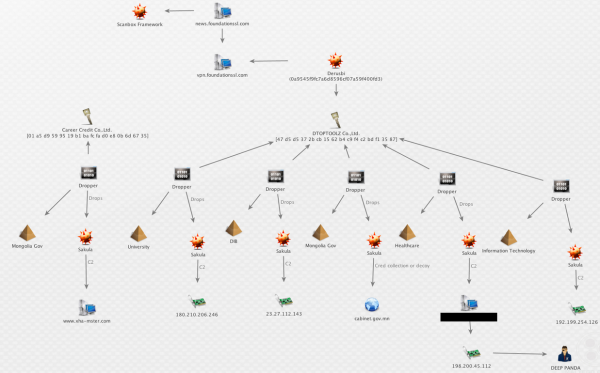
          Deep Panda is the name given to this group by security firm CrowdStrike. In November 2014, Crowdstrike published a snapshot of a graphic showing the malware and malicious Internet servers used in what security experts at PriceWaterhouseCoopers dubbed the ScanBox Framework, a suite of tools that have been used to launch a number of cyber espionage attacks.


          A Maltego transform published by CrowdStrike. The graphic is intended to illustrate some tools and Internet servers that are closely tied to a Chinese cyber espionage group that CrowdStrike calls "Deep Panda."

          Crowdstrike’s snapshot (produced with the visualization tool Maltego) lists many of the tools the company has come to associate with activity linked to Deep Panda, including a password stealing Trojan horse program called Derusbi, and an Internet address — 198[dot]200[dot]45[dot]112.

          CrowdStrike’s image curiously redacts the resource tied to that Internet address (note the black box in the image above), but a variety of open source records indicate that this particular address was until very recently the home for a very interesting domain: we11point.com. The third and fourth characters in that domain name are the numeral one, but it appears that whoever registered the domain was attempting to make it look like “Wellpoint,” the former name of Anthem before the company changed its corporate name in late 2014.

          We11point[dot]com was registered on April 21, 2014 to a bulk domain registration service in China. Eight minutes later, someone changed the site’s registration records to remove any trace of a connection to China.

          Intrigued by the fake Wellpoint domains, Rich Barger, chief information officer for Arlington, Va. security firm ThreatConnect Inc., dug deeper into so-called “passive DNS” records — historic records of the mapping between numeric Internet addresses and domain names. That digging revealed a host of other subdomains tied to the suspicious we11point[dot]com site. In the process, Barger discovered that these subdomains — including myhr.we11point[dot]com, and hrsolutions.we11point[dot]com -mimicked components of Wellpoint’s actual network as it existed in April 2014.

          “We were able to verify that the evil we11point infrastructure is constructed to masquerade as legitimate Wellpoint infrastructure,” Barger said.

          Another fishy subdomain that Barger discovered was extcitrix.we11point[dot]com. The “citrix” portion of that domain likely refers to Citrix, a software tool that many large corporations commonly use to allow employees remote access to internal networks over a virtual private network (VPN).

          Interestingly, that extcitrix.we11point[dot]com domain, first put online on April 22, 2014, was referenced in a malware scan from a malicious file that someone uploaded to malware scanning service Virustotal.com. According to the writeup on that malware, it appears to be a backdoor program masquerading as Citrix VPN software. The malware is digitally signed with a certificate issued to an organization called DTOPTOOLZ Co. According to CrowdStrike and other security firms, that digital signature is the calling card of the Deep Panda Chinese espionage group.

          CONNECTIONS TO OTHER VICTIMS?

          As noted in a story in HealthITSecurity.com, Anthem has been sharing information about the attack with the Health Information Trust Alliance (HITRUST) and the National Health Information Sharing and Analysis Center (NH-ISAC), industry groups whose mission is to disseminate information about cyber threats to the healthcare industry.

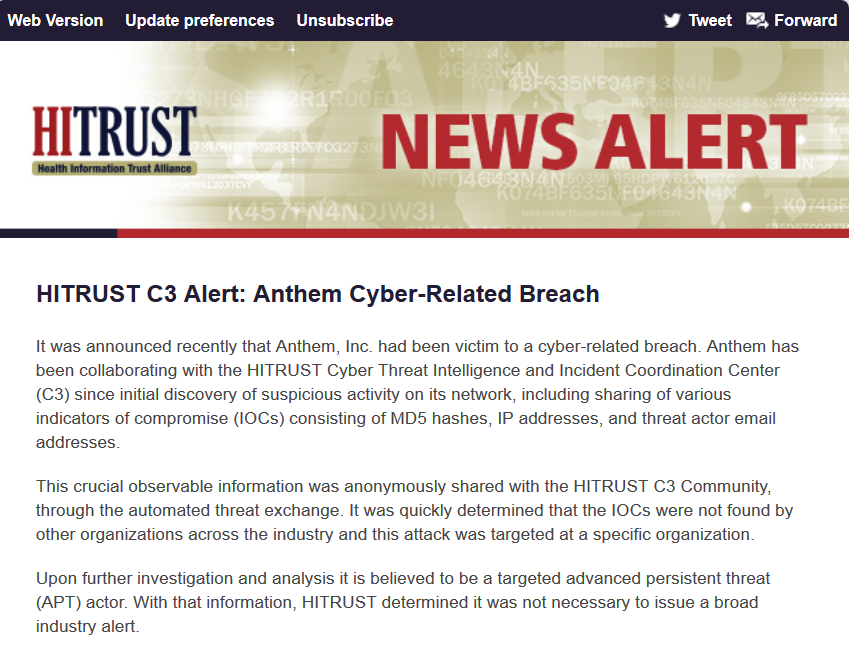
          A news alert published by HITRUST last week notes that Anthem has been sharing so-called “indicators of compromise” (IOCs) — Internet addresses, malware signatures and other information associated with the breach. “It was quickly determined that the IOCs were not found by other organizations across the industry and this attack was targeted a specific organization,” HITRUST wrote in its alert. “Upon further investigation and analysis it is believed to be a targeted advanced persistent threat (APT) actor. With that information, HITRUST determined it was not necessary to issue a broad industry alert.”


          An alert released by the Health Information Trust Alliance (HITRUST) about the APT attack on Anthem.

          But a variety of data points suggest that the same infrastructure used to attack Anthem may have been leveraged against a Reston, Va.-based information technology firm that primarily serves the Department of Defense.

          A writeup on a piece of malware that Symantec calls “Mivast” was produced on Feb. 6, 2015. It describes a backdoor Trojan that Symantec says may call out to one of a half-dozen domains, including the aforementioned extcitrix.we11point[dot]com domain and another — sharepoint-vaeit.com. Other domains on the same server include ssl-vaeit.com, and wiki-vaeit.com. Once again, it appears that we have a malware sample calling home to a domain designed to mimic the internal network of an organization — most likely VAE Inc. (whose legitimate domain is vaeit.com).

          Barger and his team at ThreatConnect discovered that the sharepoint-vaeit.com domain also was tied to a malware sample made to look like it was VPN software made by networking giant Juniper. That malware was created in May 2014, and was also signed with the DTOPTOOLZ Co. digital certificate that CrowdStrike has tied to Deep Panda.
          The Hackmaster

          Comment

          Working...
          X