 Tweet
Tweet
Evidence Noah's Biblical Flood Happened, Says Robert Ballard
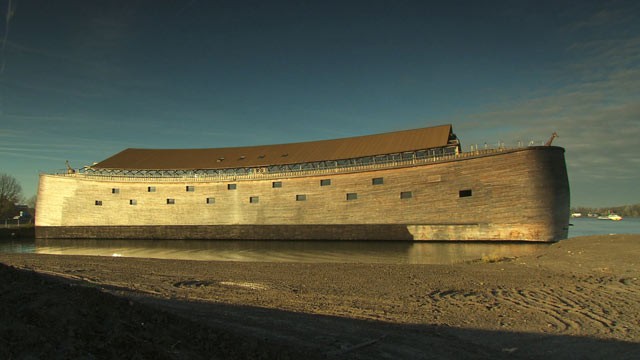
This ark, located an hour south of Amsterdam, is a replica of Noah's Biblical boat. Underwater archaeologist Robert Ballard is in Turkey, looking for evidence that the Great Flood happened. (ABC News)
By JENNA MILLMAN, BRYAN TAYLOR and LAUREN EFFRON (@LEffron831) Dec. 10, 2012
The story of Noah's Ark
and the Great Flood is one of the most famous from the Bible, and now
an acclaimed underwater archaeologist thinks he has found proof that the
biblical flood was actually based on real events.
In an interview with Christiane Amanpour for ABC News, Robert Ballard,
one of the world's best-known underwater archaeologists, talked about
his findings. His team is probing the depths of the Black Sea off the
coast of Turkey in search of traces of an ancient civilization hidden
underwater since the time of Noah.
Tune in to Christiane Amanpour's two-part ABC News special, "Back to the Beginning,"
which explores the history of the Bible from Genesis to Jesus. Part one
airs on Friday, Dec. 21 and part two on Friday, Dec. 28, both starting
at 9 p.m. ET on ABC. See photos from her journey HERE
Ballard's track record for finding the impossible is well known. In
1985, using a robotic submersible equipped with remote-controlled
cameras, Ballard and his crew hunted down the world's most famous
shipwreck, the Titanic.
Now Ballard is using even more advanced robotic technology to travel
farther back in time. He is on a marine archeological mission that might
support the story of Noah. He said some 12,000 years ago, much of the
world was covered in ice.
"Where I live in Connecticut was ice a mile above my house, all the way
back to the North Pole, about 15 million kilometers, that's a big ice
cube," he said. "But then it started to melt. We're talking about the
floods of our living history."
The water from the melting glaciers began to rush toward the world's oceans, Ballard said, causing floods all around the world.
"The questions is, was there a mother of all floods," Ballard said.
According to a controversial theory proposed by two Columbia University
scientists, there really was one in the Black Sea region. They believe
that the now-salty Black Sea was once an isolated freshwater lake
surrounded by farmland, until it was flooded by an enormous wall of
water from the rising Mediterranean Sea. The force of the water was two
hundred times that of Niagara Falls, sweeping away everything in its
path.
Fascinated by the idea, Ballard and his team decided to investigate.
"We went in there to look for the flood," he said. "Not just a slow
moving, advancing rise of sea level, but a really big flood that then
stayed... The land that went under stayed under."
Four hundred feet below the surface, they unearthed an ancient
shoreline, proof to Ballard that a catastrophic event did happen in the
Black Sea. By carbon dating shells found along the shoreline, Ballard
said he believes they have established a timeline for that catastrophic
event, which he estimates happened around 5,000 BC. Some experts
believe this was around the time when Noah's flood could have occurred.
"It probably was a bad day," Ballard said. "At some magic moment, it
broke through and flooded this place violently, and a lot of real
estate, 150,000 square kilometers of land, went under."
The theory goes on to suggest that the story of this traumatic event,
seared into the collective memory of the survivors, was passed down from
generation to generation and eventually inspired the biblical account
of Noah.
Noah is described in the Bible as a family man, a father of three, who is about to celebrate his 600th birthday.
"In the early chapters of Genesis, people live 800 years, 700 years, 900
years," said Rabbi Burt Visotzky, a professor of Talmud and Rabbinics
at the Jewish Theological Seminary in New York. "Those are mythic
numbers, those are way too big. We don't quite know what to do with
that. So sometimes those large numbers, I think, also serve to
reinforce the mystery of the text."
Some of the details of the Noah story seem mythical, so many biblical
scholars believe the story of Noah and the Ark was inspired by the
legendary flood stories of nearby Mesopotamia, in particular "The Epic
of Gilgamesh." These ancient narratives were already being passed down
from one generation to the next, centuries before Noah appeared in the
Bible.
"The earlier Mesopotamian stories are very similar where the gods are
sending a flood to wipe out humans," said biblical archaeologist Eric
Cline. "There's one man they choose to survive. He builds a boat and
brings on animals and lands on a mountain and lives happily ever after? I
would argue that it's the same story."
Catastrophic events of this kind are not unique to the Bible. Some
contemporary examples include the 2004 tsunami that wiped out villages
on the coasts of 11 countries surrounding the Indian Ocean.
There was also Hurricane Katrina, described as the worst hurricane in United
States history.
Scholars aren't sure if the biblical flood was larger or smaller than
these modern day disasters, but they do think the experiences of people
in ancient times were similar to our own.
"If you witness a terrible natural disaster, yes, you want a scientific
explanation why this has happened," said Karen Armstrong, author of "A
History of God." "But you also need to something that will help you to
assuage your grief and anguish and rage. And it is here that myth helps
us through that."
Regardless of whether the details of the Noah story are historically
accurate, Armstrong believes this story and all the Biblical stories are
telling us "about our predicament in the world now."
Back in the Black Sea, Ballard said he is aware that not everyone agrees
with his conclusions about the time and size of the flood, but he's
confident he's on the path to finding something from the biblical
period.
"We started finding structures that looked like they were man-made
structures," Ballard said. "That's where we are focusing our attention
right now."
At first Ballard's team found piles of ancient pottery, but then they
made an even more important discovery. Last year, Ballard discovered a
vessel and one of its crew members in the Black Sea.
"That is a perfectly preserved ancient shipwreck in all its wood, looks
like a lumber yard," he said. "But if you look closely, you will see the
femur bone and actually a molar."
The shipwreck was in surprisingly good condition, preserved because the
Black Sea has almost no oxygen in it, which slows down the process of
decay, but it does not date back as far as the story of Noah.
"The oldest shipwreck that we have discovered so far of that area is
around 500 BC, classical period," Ballard said. "But the question is you
just keep searching. It's a matter of statistics."
Still, Ballard said the find gives him hope that he will discover
something older "because there, in fact, the deep sea is the largest
museum on Earth," he said.
Ballard does not think he will ever find Noah's Ark, but he does think
he may find evidence of a people whose entire world was washed away
about 7,000 years ago. He and his team said they plan to return to
Turkey next summer.
"It's foolish to think you will ever find a ship," Ballard said,
referring to the Ark. "But can you find people who were living? Can you
find their villages that are underwater now? And the answer is yes."
Tune in to Christiane Amanpour's two-part ABC News special, "Back to the Beginning,"
which explores the history of the Bible from Genesis to Jesus. Part one
airs on Friday, Dec. 21 and part two on Friday, Dec. 28, both starting
at 9 p.m. ET on ABC.
This ark, located an hour south of Amsterdam, is a replica of Noah's Biblical boat. Underwater archaeologist Robert Ballard is in Turkey, looking for evidence that the Great Flood happened. (ABC News)
By JENNA MILLMAN, BRYAN TAYLOR and LAUREN EFFRON (@LEffron831) Dec. 10, 2012
The story of Noah's Ark
and the Great Flood is one of the most famous from the Bible, and now
an acclaimed underwater archaeologist thinks he has found proof that the
biblical flood was actually based on real events.
In an interview with Christiane Amanpour for ABC News, Robert Ballard,
one of the world's best-known underwater archaeologists, talked about
his findings. His team is probing the depths of the Black Sea off the
coast of Turkey in search of traces of an ancient civilization hidden
underwater since the time of Noah.
Tune in to Christiane Amanpour's two-part ABC News special, "Back to the Beginning,"
which explores the history of the Bible from Genesis to Jesus. Part one
airs on Friday, Dec. 21 and part two on Friday, Dec. 28, both starting
at 9 p.m. ET on ABC. See photos from her journey HERE
Ballard's track record for finding the impossible is well known. In
1985, using a robotic submersible equipped with remote-controlled
cameras, Ballard and his crew hunted down the world's most famous
shipwreck, the Titanic.
Now Ballard is using even more advanced robotic technology to travel
farther back in time. He is on a marine archeological mission that might
support the story of Noah. He said some 12,000 years ago, much of the
world was covered in ice.
"Where I live in Connecticut was ice a mile above my house, all the way
back to the North Pole, about 15 million kilometers, that's a big ice
cube," he said. "But then it started to melt. We're talking about the
floods of our living history."
The water from the melting glaciers began to rush toward the world's oceans, Ballard said, causing floods all around the world.
"The questions is, was there a mother of all floods," Ballard said.
According to a controversial theory proposed by two Columbia University
scientists, there really was one in the Black Sea region. They believe
that the now-salty Black Sea was once an isolated freshwater lake
surrounded by farmland, until it was flooded by an enormous wall of
water from the rising Mediterranean Sea. The force of the water was two
hundred times that of Niagara Falls, sweeping away everything in its
path.
Fascinated by the idea, Ballard and his team decided to investigate.
"We went in there to look for the flood," he said. "Not just a slow
moving, advancing rise of sea level, but a really big flood that then
stayed... The land that went under stayed under."
Four hundred feet below the surface, they unearthed an ancient
shoreline, proof to Ballard that a catastrophic event did happen in the
Black Sea. By carbon dating shells found along the shoreline, Ballard
said he believes they have established a timeline for that catastrophic
event, which he estimates happened around 5,000 BC. Some experts
believe this was around the time when Noah's flood could have occurred.
"It probably was a bad day," Ballard said. "At some magic moment, it
broke through and flooded this place violently, and a lot of real
estate, 150,000 square kilometers of land, went under."
The theory goes on to suggest that the story of this traumatic event,
seared into the collective memory of the survivors, was passed down from
generation to generation and eventually inspired the biblical account
of Noah.
Noah is described in the Bible as a family man, a father of three, who is about to celebrate his 600th birthday.
"In the early chapters of Genesis, people live 800 years, 700 years, 900
years," said Rabbi Burt Visotzky, a professor of Talmud and Rabbinics
at the Jewish Theological Seminary in New York. "Those are mythic
numbers, those are way too big. We don't quite know what to do with
that. So sometimes those large numbers, I think, also serve to
reinforce the mystery of the text."
Some of the details of the Noah story seem mythical, so many biblical
scholars believe the story of Noah and the Ark was inspired by the
legendary flood stories of nearby Mesopotamia, in particular "The Epic
of Gilgamesh." These ancient narratives were already being passed down
from one generation to the next, centuries before Noah appeared in the
Bible.
"The earlier Mesopotamian stories are very similar where the gods are
sending a flood to wipe out humans," said biblical archaeologist Eric
Cline. "There's one man they choose to survive. He builds a boat and
brings on animals and lands on a mountain and lives happily ever after? I
would argue that it's the same story."
Catastrophic events of this kind are not unique to the Bible. Some
contemporary examples include the 2004 tsunami that wiped out villages
on the coasts of 11 countries surrounding the Indian Ocean.
There was also Hurricane Katrina, described as the worst hurricane in United
States history.
Scholars aren't sure if the biblical flood was larger or smaller than
these modern day disasters, but they do think the experiences of people
in ancient times were similar to our own.
"If you witness a terrible natural disaster, yes, you want a scientific
explanation why this has happened," said Karen Armstrong, author of "A
History of God." "But you also need to something that will help you to
assuage your grief and anguish and rage. And it is here that myth helps
us through that."
Regardless of whether the details of the Noah story are historically
accurate, Armstrong believes this story and all the Biblical stories are
telling us "about our predicament in the world now."
Back in the Black Sea, Ballard said he is aware that not everyone agrees
with his conclusions about the time and size of the flood, but he's
confident he's on the path to finding something from the biblical
period.
"We started finding structures that looked like they were man-made
structures," Ballard said. "That's where we are focusing our attention
right now."
At first Ballard's team found piles of ancient pottery, but then they
made an even more important discovery. Last year, Ballard discovered a
vessel and one of its crew members in the Black Sea.
"That is a perfectly preserved ancient shipwreck in all its wood, looks
like a lumber yard," he said. "But if you look closely, you will see the
femur bone and actually a molar."
The shipwreck was in surprisingly good condition, preserved because the
Black Sea has almost no oxygen in it, which slows down the process of
decay, but it does not date back as far as the story of Noah.
"The oldest shipwreck that we have discovered so far of that area is
around 500 BC, classical period," Ballard said. "But the question is you
just keep searching. It's a matter of statistics."
Still, Ballard said the find gives him hope that he will discover
something older "because there, in fact, the deep sea is the largest
museum on Earth," he said.
Ballard does not think he will ever find Noah's Ark, but he does think
he may find evidence of a people whose entire world was washed away
about 7,000 years ago. He and his team said they plan to return to
Turkey next summer.
"It's foolish to think you will ever find a ship," Ballard said,
referring to the Ark. "But can you find people who were living? Can you
find their villages that are underwater now? And the answer is yes."
Tune in to Christiane Amanpour's two-part ABC News special, "Back to the Beginning,"
which explores the history of the Bible from Genesis to Jesus. Part one
airs on Friday, Dec. 21 and part two on Friday, Dec. 28, both starting
at 9 p.m. ET on ABC.