 Tweet
Tweet
By Brian Krebs
My phone and email have been flooded with questions and interview requests from various media outlets since security consultancy Hold Security dropped the news that a Russian gang has stolen more than a billion email account credentials. Rather than respond to each of these requests in turn, allow me to add a bit of perspective here in the most direct way possible: The Q&A.
Q: Who the heck is Alex Holden?
A: I’ve known Hold Security’s Founder Alex Holden for nearly seven years. Coincidentally, I initially met him in Las Vegas at the Black Hat security convention (where I am now). Alex is a talented and tireless researcher, as well as a forthright and honest guy. He is originally from Ukraine, and speaks/reads Russian and Ukrainian fluently. His research has been central to several of my big scoops over the past year, including the breach at Adobe that exposed tens of millions of customer records.
Q: Is this for real?
A: Alex isn’t keen on disclosing his methods, but I have seen his research and data firsthand and can say it’s definitely for real. Without spilling his secrets or methods, it is clear that he has a first-hand view on the day-to-day activities of some very active organized cyber-crime networks and actors.
Q: OK, but more than a billion credentials? That seems like a lot.
A: For those unfamiliar with the operations of large-scale organized crime syndicates, yes, it does. Unfortunately, there are more than a few successful cyber crooks who are quite good at what they do, and do it full-time. These actors — mostly spammers and malware purveyors (usually both) — focus on acquiring as many email addresses and account credentials as they can. Their favorite methods of gathering this information include SQL injection (exploiting weaknesses in Web sites that can be used to force the site to cough up user data) and abusing stolen credentials to steal even more credentials from victim organizations.
One micro example of this: Last year, I wrote about a botnet that enslaved thousands of hacked computers which disguised itself as a legitimate add-on for Mozilla Firefox and forced infected PC's to scour Web sites for SQL vulnerabilities.
Q: What would a crime network even do with a billion credentials?
A: Spam, spam and….oh, spam. Junk email is primarily sent in bulk using large botnets — collections of hacked PC's. A core component of the malware that powers these crime machines is the theft of passwords that users store on their computers and the interception of credentials submitted by victims in the process of browsing the Web. It is quite common for major spammers to rely on lists of billions of email addresses for distributing their malware and whatever junk products they are getting paid to promote.
Another major method of spamming (called “Webspam”) involves the use of stolen email account credentials — such as Gmail, Yahoo and Outlook — to send spam from victim accounts, particularly to all of the addresses in the contacts list of the compromised accounts.
Spam is such a core and fundamental component of any large-scale cyber crime operation that I spent the last four years writing an entire book about it, describing how these networks are created, the crooks that run them, and the cyber crime kingpins who make it worth their while. More information about this book and ways to pre-order it before its release in November is available here.
Q: Should I be concerned about this?
A: That depends. If you are the type of person who re-uses passwords at multiple sites — including email accounts — then the answer is yes. If you re-use your email password at another site and that other site gets hacked, there is an excellent chance that cyber crooks are plundering your inbox and using it to spam your friends and family to spread malware and to perpetuate the cyber crime food chain.
For a primer that attempts to explain the many other reasons that crooks might want to hack your inbox, your inbox’s relative market value, and what you can do to secure it, please see The Value of a Hacked Email Account and Tools for a Safer PC.
Got more questions? Sound off in the comments section and I’ll try to address them when time permits.
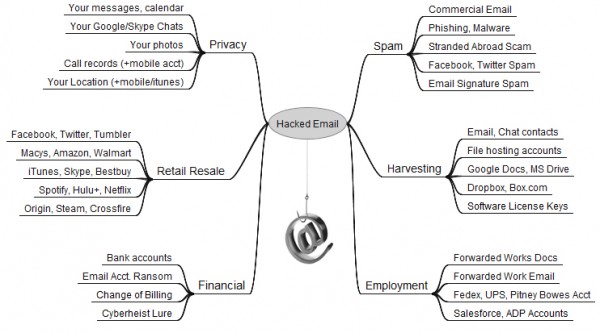
Your email account may be worth far more than you imagine.
My phone and email have been flooded with questions and interview requests from various media outlets since security consultancy Hold Security dropped the news that a Russian gang has stolen more than a billion email account credentials. Rather than respond to each of these requests in turn, allow me to add a bit of perspective here in the most direct way possible: The Q&A.
Q: Who the heck is Alex Holden?
A: I’ve known Hold Security’s Founder Alex Holden for nearly seven years. Coincidentally, I initially met him in Las Vegas at the Black Hat security convention (where I am now). Alex is a talented and tireless researcher, as well as a forthright and honest guy. He is originally from Ukraine, and speaks/reads Russian and Ukrainian fluently. His research has been central to several of my big scoops over the past year, including the breach at Adobe that exposed tens of millions of customer records.
Q: Is this for real?
A: Alex isn’t keen on disclosing his methods, but I have seen his research and data firsthand and can say it’s definitely for real. Without spilling his secrets or methods, it is clear that he has a first-hand view on the day-to-day activities of some very active organized cyber-crime networks and actors.
Q: OK, but more than a billion credentials? That seems like a lot.
A: For those unfamiliar with the operations of large-scale organized crime syndicates, yes, it does. Unfortunately, there are more than a few successful cyber crooks who are quite good at what they do, and do it full-time. These actors — mostly spammers and malware purveyors (usually both) — focus on acquiring as many email addresses and account credentials as they can. Their favorite methods of gathering this information include SQL injection (exploiting weaknesses in Web sites that can be used to force the site to cough up user data) and abusing stolen credentials to steal even more credentials from victim organizations.
One micro example of this: Last year, I wrote about a botnet that enslaved thousands of hacked computers which disguised itself as a legitimate add-on for Mozilla Firefox and forced infected PC's to scour Web sites for SQL vulnerabilities.
Q: What would a crime network even do with a billion credentials?
A: Spam, spam and….oh, spam. Junk email is primarily sent in bulk using large botnets — collections of hacked PC's. A core component of the malware that powers these crime machines is the theft of passwords that users store on their computers and the interception of credentials submitted by victims in the process of browsing the Web. It is quite common for major spammers to rely on lists of billions of email addresses for distributing their malware and whatever junk products they are getting paid to promote.
Another major method of spamming (called “Webspam”) involves the use of stolen email account credentials — such as Gmail, Yahoo and Outlook — to send spam from victim accounts, particularly to all of the addresses in the contacts list of the compromised accounts.
Spam is such a core and fundamental component of any large-scale cyber crime operation that I spent the last four years writing an entire book about it, describing how these networks are created, the crooks that run them, and the cyber crime kingpins who make it worth their while. More information about this book and ways to pre-order it before its release in November is available here.
Q: Should I be concerned about this?
A: That depends. If you are the type of person who re-uses passwords at multiple sites — including email accounts — then the answer is yes. If you re-use your email password at another site and that other site gets hacked, there is an excellent chance that cyber crooks are plundering your inbox and using it to spam your friends and family to spread malware and to perpetuate the cyber crime food chain.
For a primer that attempts to explain the many other reasons that crooks might want to hack your inbox, your inbox’s relative market value, and what you can do to secure it, please see The Value of a Hacked Email Account and Tools for a Safer PC.
Got more questions? Sound off in the comments section and I’ll try to address them when time permits.
Your email account may be worth far more than you imagine.